Louisa Catherine Adams by Louisa Thomas

True strength begins with self-knowledge and reflection.

This essay was first published by In Pursuit, an initiative of More Perfect, a bipartisan alliance of over 43 presidential centers and many of the country’s leading educational and civic initiatives. Visit https://inpursuit.substack.com/ to learn more about the project.

Louisa Catherine Adams was raised as many young, wealthy women in London at the end of the eighteenth century were raised: to be a domesticated songbird, pretty in voice and plumage. Had the cage been better gilded, she might not have noticed it. But when she and John Quincy arrived at the White House, in January 1825, they found it in disrepair. The furniture was threadbare and rooms drafty, with naked plaster for walls. Some parts of the building were closed off, unrepaired a decade after the British had burned it. After years in the courts of Europe as a diplomat’s wife, Louisa was shocked to find the president’s house so undignified. But what made her feel trapped in a terrible situation wasn’t the condition of the building. It was the sense of isolation. “There is something in this great unsocial home which depresses my spirits beyond expression,” she wrote to her son, “and makes it impossible for me to feel at home or fancy that I have a home anywhere.” 

Louisa’s new life in that depressing White House was a world away from her cosmopolitan upbringing. The house she’d grown up in was on Tower Hill, above the River Thames. Louisa spoke French, played the harp, attended parties, and was known for her fine soprano voice. John Quincy Adams met her as a young diplomat visiting London from the Hague and fell in love with her – though he tried to deny himself. There was too much pleasure in her company, he grumbled to his diary. They were an odd fit: he distrusted society; she was built for it. It turned out he would need her, however much he sometimes might have wanted to deny that too. 

“She was far from a nobody, and more than just a songbird in a cage.”

Louisa was crucial to John Quincy’s ascent. She navigated the complexities of being a young republican’s wife in the opulent courts of Prussia, St. Petersburg, and England. In the United States, while John Quincy was Secretary of State during the Monroe administration, she was sought after and admired. This was important: John Quincy judged himself “a man of reserved, cold, austere, and forbidding manners,” and many of those who met him agreed. He wanted to believe he did nothing to put himself in position to become president – that it was merely a question of merit, of disinterested duty well executed. That was what his parents, John and Abigail Adams, had preached. But the country was changing. Democracy was expanding. More men could vote, and fewer had the kind of classical education in civic duty that John Quincy took for granted. John Quincy needed allies in Washington. Relationships mattered. That was not his strength, but it was his wife’s. And so he encouraged her social life. 

In Washington, Louisa made her parlor a power center, through her balls and Tuesday “tea parties.” In her diary, she would count the senators who came through the door and list the Cabinet members. She denied any influence, and accepted the idea, common to her time, that women should stay out of politics. But she called her parties in the years before the 1824 election “my campaigne.” When she spent a summer in Philadelphia, generals and senators would come by to discuss the latest news. In her reports back to her husband she tried to help him understand that the public wanted a leader people could relate to, not merely a tribune. “You are under a great error as it regards the interest of the late correspondence; the personal part of it has been the only part which has really occupied the publick mind, and it has placed you before the world in the character of a private individual, suffering under an unjust and ungenerous persecuted,” she wrote after one episode in which he’d been wronged. “In this light alone it is viewed and in this light it is powerfully felt, because every man can understand it and make the case his own.” He had done well to show himself “not as a negotiator of treaties alone,” she wrote, “but as an able man.” John Quincy understood the power of feelings to move people. He had also grown up in an age of sensibility. But often he wore, his son Charles once wrote, “an iron mask.” 

Harp of Louisa Catherine Adams

John Quincy’s presidency was doomed almost before it began. The 1824 election was a disaster – narrowly won by John Quincy in a vote decided by the House of Representatives. Andrew Jackson’s supporters were already organizing and planning for his defeat in 1828. But as President, John Quincy refused to do anything that might smack of “electioneering.” When Louisa encouraged him to meet with his supporters, he chided her. “My journeys and my visits wherever they may be shall have no connection with the Presidency,” he wrote. “I am sincerely sorry for it,” she replied—with more frustration than sympathy. While he struggled to push through his agenda, she wandered the northeast or lay sick in her bed. 

As president, determined to show his independence, without strong allies, and under the increasing pressure from his political opponents, John Quincy’s ambitious program faltered. 

Louisa felt herself faltering too. In the White House, her parties, which had been at the center of Washington’s social life, were replaced by a series of formal “drawing room” gatherings. Once praised for her conviviality, she was criticized for her stiffness. Aware of her constrained position, she seems to have disliked those events herself. Only when Adams lost the 1828 election, the prospect of departure from the White House revived her. In her last “drawing room,” the doors of the East Room were opened, a band was hired, and for the first time since the Adamses had arrived in the President’s House, there was dancing. 

Louisa never wanted to be used merely as an instrument for her husband’s political ambitions. She never believed that women should involve themselves directly in politics. She could be melodramatic and felt uneducated. She was not like her mother-in-law, Abigail, who was John Adams’s wise counselor throughout his life. But Louisa was resourceful, a voracious reader, and had remarkably varied experiences for her time. She was a sharp and witty observer of people and their passions, their follies, their ambitions. “Now I like very well to adopt my husband’s thoughts and words when I approve them,” she wrote to John Quincy at the age of seventy, “but I do not like to repeat them like a parrot, and prove myself a nonentity. When my husband married me, he made a great mistake if he thought I only intended to play an echo.” Indeed, she was not a nonentity – and perhaps John Quincy would have had a more successful presidency if he had done more during those years to appreciate that.

“When my husband married me, he made a great mistake if he thought I only intended to play an echo.”
– Louisa Adams

Not long after leaving Washington, Louisa was brought back to the city against her will. John Quincy allowed himself to be elected to Congress, apparently without telling her. But his last act in politics was different – for both of them. 

While John Quincy Adams led the crusade against slavery in the House of Representatives, Louisa began to question the limits put upon her as a woman and to assert more of herself – her hopes, her regrets, her sense of humor, her sense of injustice. John Quincy found his great calling, and in surprising ways, she found her voice. She wrote not only letters but poetry, plays, and several drafts of memoir sketches, in a vivid style. Her “Narrative of a Journey from Russia to France” (1835) recounted the harrowing tale of her travel through Europe during the Napoleonic Wars. Later, she began a letter to her son Charles that soon became an honest, at times painful, memoir that she called “Adventures of a Nobody” (1840). But in her writing Louisa discovered that she was far from a nobody, and more than just a songbird in a cage. She wanted to show, she wrote, that she was “one, who was.” 

John Quincy Adams by Lindsay Chervinsky

Short-term defeat Does not end long-term influence.

This essay was first published by In Pursuit, an initiative of More Perfect, a bipartisan alliance of over 43 presidential centers and many of the country’s leading educational and civic initiatives. Visit https://inpursuit.substack.com/ to learn more about the project.

John Quincy Adams held almost every conceivable position in the United States government: secretary to American envoys, minister abroad, senator, secretary of state, congressman, and of course, president. Yet, he is rarely associated with his tenure in the country’s most powerful office. Instead, he is remembered for a series of successful diplomatic postings, his masterful formulation of foreign policy as secretary of state, and an unprecedented and never repeated post-presidential congressional career marked by his tenacious fight against slavery.

Adams’s career produced a vision for the future of the United States and its role in the world. As president, he pitched this vision to the American people. At that moment, they did not have the good sense to embrace it. Future generations, however, have drawn inspiration from Adams’s vision—and his guidance is more relevant in the twenty-first century than ever. Adams’s presidency cannot be separated from the rest of his lengthy career, and it reminds us that visionary leaders leave a lasting impact long after their time in office.

John Quincy’s early career delivered several important lessons about global politics and the United States’ place in the world. At twelve years old, he sailed to Paris to serve as his father’s secretary. A few years later, he accompanied American envoy Francis Dana to St. Petersburg to serve as a translator. Watching the elder Adams and Dana navigate a series of diplomatic defeats in France and Russia, John Quincy learned the hard way that the new United States held little power and influence. He also observed that the powerful empires willingly used the U.S. as a pawn in their centuries-long battles.

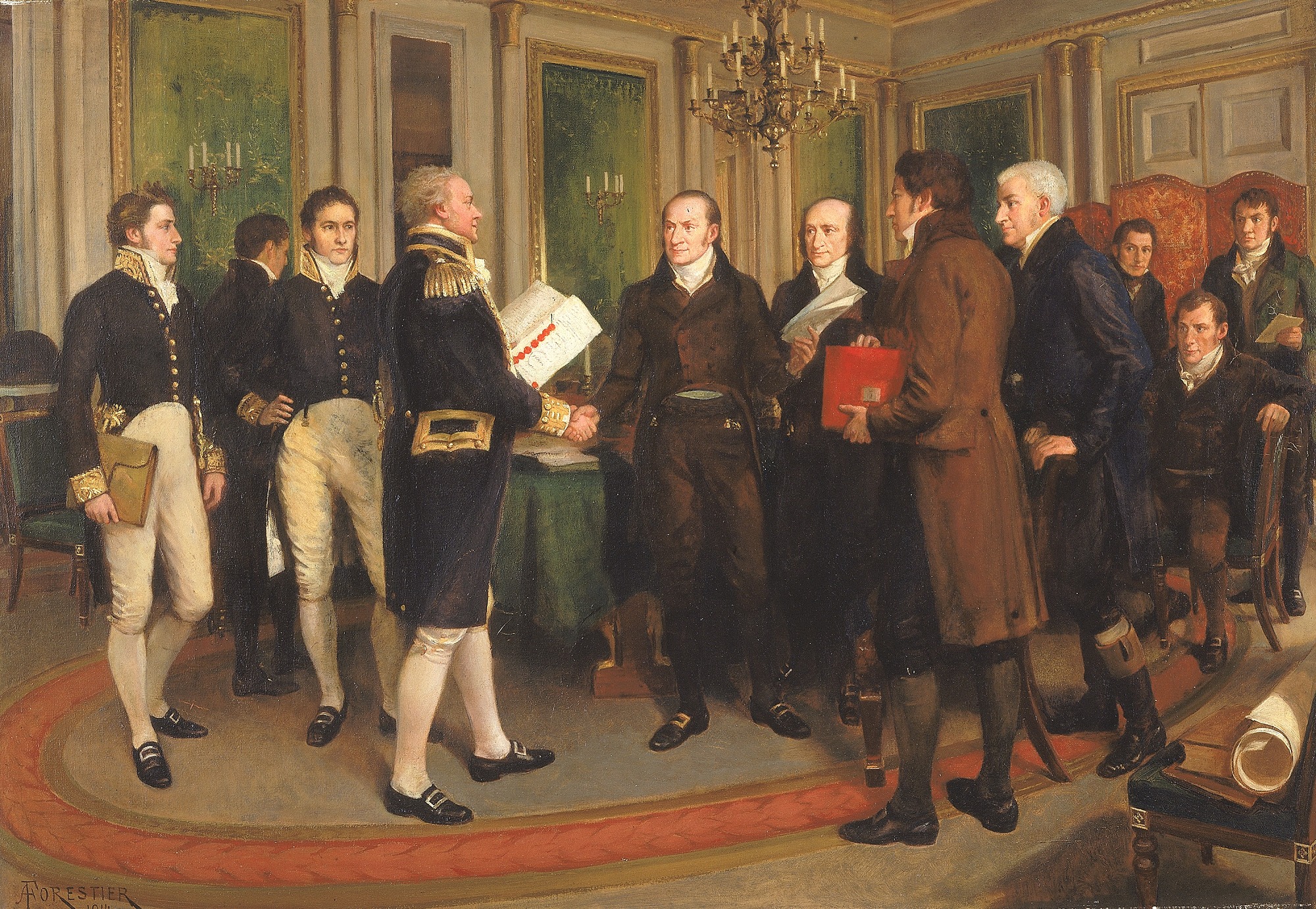
The Signing of the Treaty of Ghent, Christmas Eve, 1814 | Sir Amédée Forestier
‍

A few decades later, Adams occupied the most powerful positions in the diplomatic corps as the lead negotiator to end the War of 1812, the Ambassador to Great Britain, and the secretary of state. As Adams acquired experience, wisdom, and power, the young nation paralleled his rise. By 1820, the United States had steadily expanded west and south, displacing Native nations, and filling the land with white settlers and black enslaved workers. The American population had exploded, from 2 million in 1767 when John Quincy Adams was born to 9.6 million in 1820, and its economic power reflecting the growing demand.

The United States was still far from the global superpower that it would become, but Adams could envision the possibilities. As secretary of state, he crafted a foreign policy that would make that future possible. His vision centered on three policies: expanding the nation’s territory when it did not threaten the nation’s unity; participating vigorously in the global community while remaining wary of imperial ambitions in Europe; and defending the Union against threats foreign and domestic, especially slavery. 

To pursue that vision, Adams engineered the purchase of the Floridas from Spain and staked the first claim to the Oregon territory. But Adams did not support unchecked imperialism within the confines of North America or the western hemisphere. He resisted expansion for the purposes of strengthening slavery, believing that the spread of enforced bondage would only undermine the bonds of Union.

Adams also used his platform to deter his fellow Americans and their European counterparts from meddling in the affairs of other nations. In an address on July 4, 1821—45 years into the life of the fledgling United States—Secretary of State John Quincy Adams famously declared that America, “goes not abroad, in search of monsters to destroy.” He explained that the country was “the well-wisher to the freedom and independence of all,” but that it had to be “the champion and vindicator only of her own.” Should the nation engage in “wars of interest and avarice,” he cautioned, then “She would be no longer the ruler of her own spirit.” Adams understood that enforcing American principles abroad would corrode the character of the nation.

“Should the nation engage in ‘wars of interest and avarice’…she would be no longer the ruler of her own spirit.”
– John Quincy Adams

Two years later, he issued a similar warning to European nations. Adams wrote an official dispatch to Russia, a letter to Great Britain, and President Monroe’s annual address to Congress, all of which combined to form a policy declaration that “the American continents” had declared independence and henceforth are closed to “future colonization by any European powers.” This policy became known as the Monroe Doctrine, but it was Adams’s creation, and it defined American foreign policy for the nineteenth century.

As president, John Quincy Adams built on this vision of a strong, prosperous, virtuous America. He proposed infrastructure and education legislation to boost American industry and knit the fracturing Union together. He planted a nursery of saplings at the White House representing key moments from the nation’s history—including an acorn from the Tree of Liberty around which the Sons of Liberty gathered in Boston—and seeds from the oak tree in Baltimore that bore the scars of cannon fire from the War of 1812. He hoped that this reminder of their shared history would bind together his fellow citizens.

Adams also believed in a future where independent republics allied together against their enemies. In a presidential address to Congress, he argued that “any attempt” by European empires to extend their imperial reach “to any portion of this hemisphere” should be viewed as a threat “to our peace and safety.” Adams understood that dangerous forces across the Atlantic rarely stayed there.

Despite the wisdom in Adams’s proposals, partisan animosities, fracturing political coalitions, and the rise of new demographics defeated his vision. Martin Van Buren and Andrew Jackson, leaders of the emerging Democratic Party, coordinated to stymie the Adams administration in Congress. They also tapped into the enthusiasm of the swelling ranks of white male voters, who had recently gained suffrage with the abolition of property requirements. Many of these voters resented the New England intellectual elite embodied by John Quincy Adams and clamored for a less restrained type of politics, which the patrician Adams was uniquely unsuited to provide.

Adams’s proposals were shot down in Congress and he lost the election of 1828, but he had the final word. President Andrew Jackson’s allies in Congress passed infrastructure legislation that they had rejected just a few years earlier, including funds for a national road that connected Ohio to existing roadways. The proposals had not changed, just the president proposing them.

Daguerreotype of John Quincy Adams
‍

Rather than slinking into a quiet retirement, Adams did what no American president before or since has done: he returned to Congress. From the floor of the House of Representatives, Adams vehemently defended the Union for the next seventeen years against the threat posed by slavery. He successfully defeated the so-called “gag rule,” which sought to prevent northerners from discussing slavery on the floor of Congress, and won an argument in front of the Supreme Court in United States v. Amistad, securing the freedom of 35 Africans captured from Sierra Leone and forced into slavery. He also presciently warned that slavery would only be destroyed through blood and violence.

While his prophecies about civil war proved accurate, so too did his hope for the nation’s potential. President Theodore Roosevelt embraced the connection between natural preservation and the nation’s history, designating 230 million acres for conservation. President Woodrow Wilson outlined his Fourteen Points for international relations centering around the concept of self-determination, which Adams had championed in his July 4 speech. Finally, President Franklin D. Roosevelt understood the United States was more powerful alongside like-minded allies, just as Adams had argued in his presidential address.

As the global community enters a new era in the twenty-first century—characterized by shifting alliances, evolving power dynamics, and unpredictability—many Americans are rethinking their place in the world. John Quincy Adams’s vision served the nation in its founding and remains a guiding light as the nation celebrates its 250th birthday. This wisdom, and its lasting legacy, is a reminder that presidential leadership is timeless.

“Presidential leadership is timeless.”

In Pursuit is a landmark initiative of More Perfect, a bipartisan alliance of 43 Presidential Centers, National Archives Foundation, American Academy of Arts and Sciences, Karsh Institute for Democracy at the University of Virginia, and more than 100 organizations working together to protect and renew our democracy as we approach the 250th anniversary of the Declaration of Independence and beyond.

James Monroe by Stewart McLaurin

The hardest work of leadership comes after victory.

This essay was first published by In Pursuit, an initiative of More Perfect, a bipartisan alliance of over 43 presidential centers and many of the country’s leading educational and civic initiatives. Visit https://inpursuit.substack.com/ to learn more about the project.

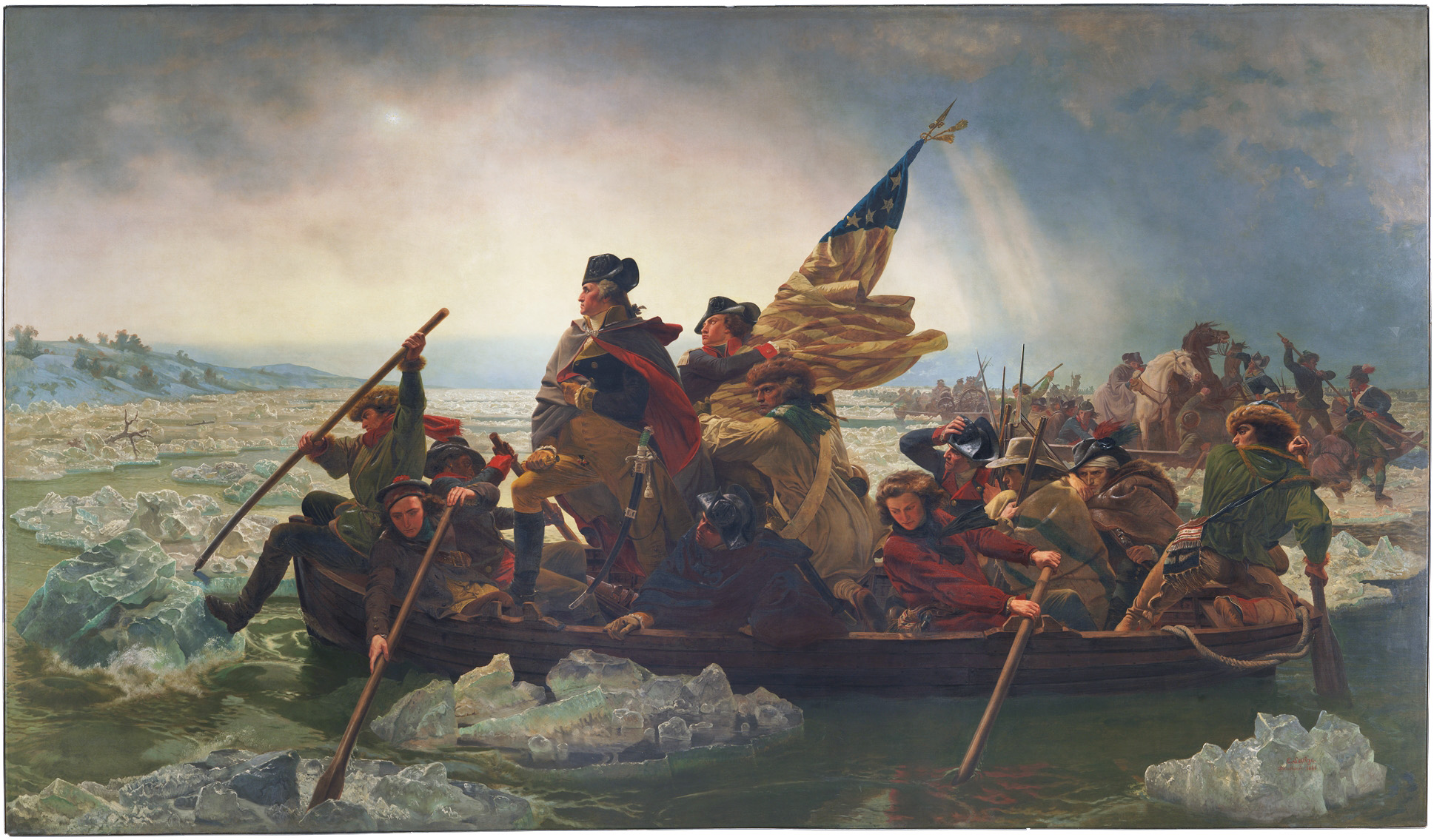
In Emanuel Leutze’s iconic painting of Washington Crossing the Delaware, James Monroe is depicted standing next to George Washington, holding high an American flag. Though Leutze took several artistic liberties—Monroe and Washington didn’t share a boat, and the flag Monroe hoists in the painting would not be designed for another decade—Monroe did indeed serve with distinction in the Revolutionary War. He survived a serious wound at the Battle of Trenton in 1776 and earned commendations for his bravery. Monroe’s legacy, however, owes less to his military exploits during the Revolution than to his role steering the early republic after the battles had been won.

Washington Crossing the Delaware | Emanuel Leutze
‍

Born in 1758, and coming of age under the direct tutelage of Thomas Jefferson and James Madison, Monroe was an important bridge between the Founding generation and the post-independence era. If the Revolution secured American independence, Monroe helped secure its durability. His efforts underscore that the hardest work of leadership often comes after victory—when ideals must be translated into institutions, unity must be preserved without an obvious enemy, and a fragile republic must be steadied for the long haul.

Monroe’s rapid ascent reflected not only his ambition, but a country learning how to govern itself. By twenty-five, Monroe sat in the Virginia House of Delegates; by twenty-seven, he was a delegate to the Congress of the Confederation; by thirty-two, a United States senator. It would take him until the age of forty-one to become governor of Virginia, which he did twice, his terms bookending diplomatic service as the United States’ minister to France and then to the United Kingdom. Additional stints as secretary of war and secretary of state followed before Monroe was elected the nation’s fifth president in 1816.

The so-called “Era of Good Feelings” Monroe ushered in posed its own test. The decline of the Federalist Party had left Monroe’s Democratic-Republicans dominant, producing a period of relative national unity; when Monroe stood for reelection in 1820, he swept every state in the Union. But governing without a robust opposition required restraint and vigilance, as well as a steady hand to balance individual liberty with collective strength.

“Monroe helped secure its durability.”

Perhaps nowhere was the challenge of post-revolutionary leadership more fraught than with the issue of slavery. Monroe had helped negotiate the Louisiana Purchase from France—doubling the size of the United States. Expansion, however, magnified a problem independence had left unresolved. When Missouri became the first state from the Louisiana Territory to petition to join the union, the question of whether to allow slavery into the new territories threatened to upset the delicate sectional balance between free and slave states and potentially sunder the infant nation. By admitting both Missouri and Maine into the union—one slave, one free—the Missouri Compromise of 1820 shelved the dispute long enough to buy time for the fragile nation.

Even with many of the Framers still living, the United States under Monroe grappled with how to apply the blueprint of the Constitution to the evolving needs of the nation. Projects such as the Cumberland Road—the country’s first-federally funded highway—promised to bind the republic together by facilitating westward expansion and economic integration yet also surfaced unresolved questions about the scope of federal power. Believing that Congress lacked the authority to administer and regulate infrastructure like the Cumberland, Monroe vetoed legislation authorizing the federal collection of tolls, before changing his mind and approving such a system. A similar tension emerged in the aftermath of the Panic of 1819, the nation’s first major financial crisis, when Monroe—despite public anger and lingering unease over Congress’s power to charter a national bank—supported the stabilizing role of the Second Bank of the United States. Many of the nation’s landmark Supreme Court cases were decided during this period.

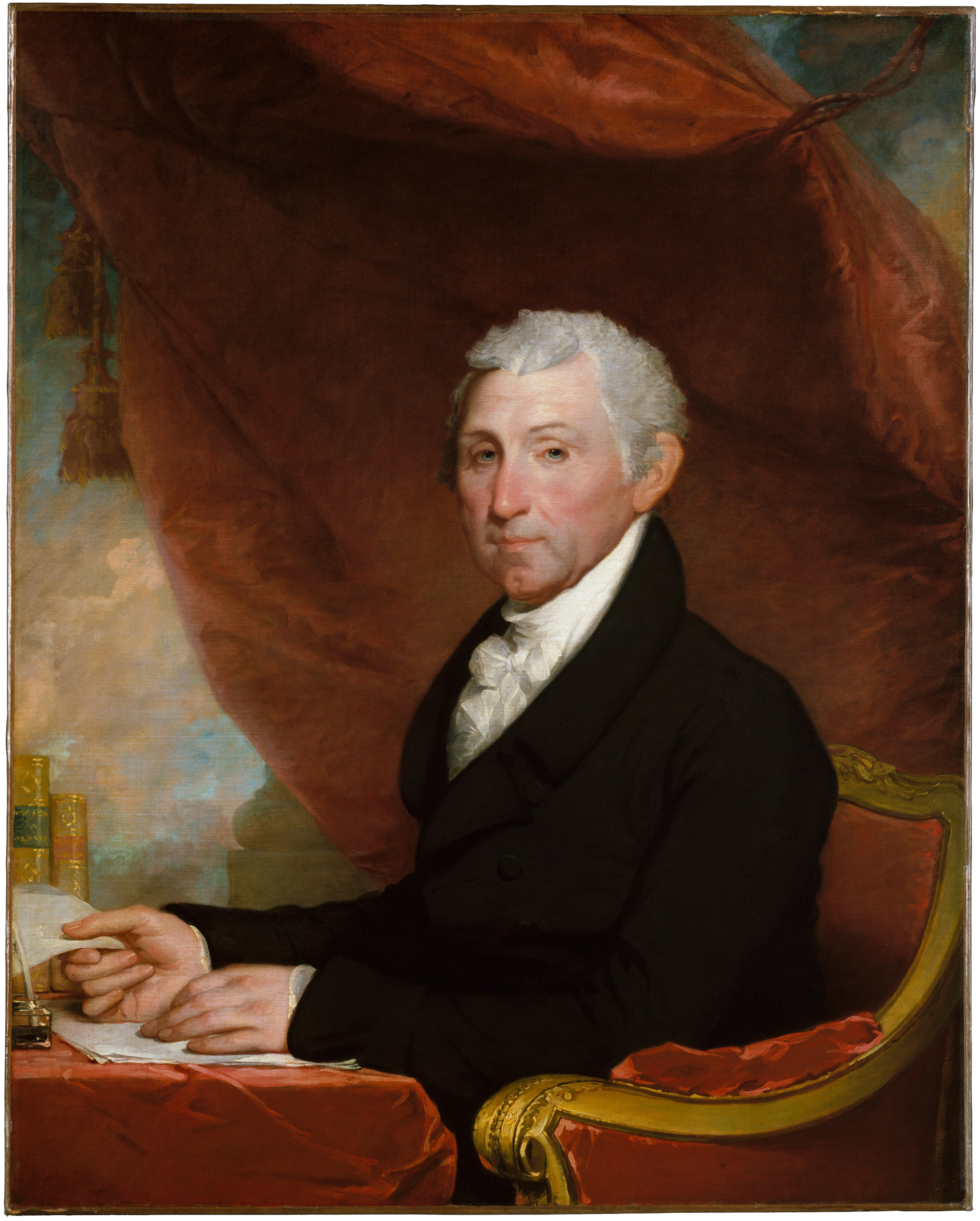
James Monroe | Gilbert Stuart
‍

It was in the United States’ relations with foreign powers, however, that Monroe left his greatest mark. Having helped to purchase Louisiana from the French, the nationalistic Monroe—and his similarly nationalistic secretary of state, John Quincy Adams—exploited the outbreak of revolution in Spain’s Latin American colonies to acquire Florida from the Spanish. In 1823, Monroe went further, declaring the Western Hemisphere off-limits to European colonization and asserting the United States as protector of the Americas. It would be decades before the United States was militarily strong enough to enforce this so-called Monroe Doctrine. Still, it became a cornerstone of United States foreign policy, reflecting Monroe’s vision of a confident nation and anticipating America’s rise as a global power.

Even as he warned European powers to keep their armies out, Monroe readily imported the cultural trappings of the Old World. Influenced by his diplomatic service in France, and his lifelong friendship with the Marquis de Lafayette, a Revolutionary comrade-in-arms, Monroe introduced an elegant French flair to the presidential residence. That included commissioning pieces like the gilded Bellangé furniture—still in use today—to enhance the young nation’s prestige and project a more refined, cosmopolitan America.

Monroe likewise collaborated with White House architect James Hoban, an Irish-born designer with a penchant for European-inspired architecture, to add the iconic South Portico to the White House. Inspired by French chateaux and neoclassical ideals, the South Portico enhanced the building’s grandeur, aligning it with the dignified residences of European capitals. Its graceful columns and commanding presence have made it one of the most universally recognized elements of American government, elevating the building from a functional residence to a symbol of national pride and power.

Monroe also became a model of generational leadership—absorbing wisdom from those who came before, applying it with steady pragmatism during times of transition, and then empowering successors to chart a confident course forward. His trust in John Quincy Adams as Secretary of State not only produced the Monroe Doctrine, but groomed Adams for the presidency, where he carried forward nationalist and hemispheric visions. Similarly, Monroe’s decisions during the Seminole conflicts and Florida acquisition elevated Andrew Jackson’s profile, strengthened executive authority in foreign affairs, and set precedents for presidential action that Jackson would later expand dramatically. The Doctrine itself echoed through decades, invoked by Polk for westward expansion, adapted by later leaders like Theodore Roosevelt to justify intervention abroad, and cited as a guiding principle of American independence in the hemisphere.

Though more understated than his more famous Virginian predecessors, Monroe was the youthful architect of a nation destined for greatness. His presidency was a high-water mark of unity and quiet confidence, carrying the revolutionary spirit onward while preparing the nation for its bolder future.

“Monroe was the youthful architect of a nation destined for greatness.”

After a lifetime of public service and financial hardship, Monroe died penniless in New York City on July 4, 1831—the 55th anniversary of independence. Yet his legacy endures not merely in a portico’s columns, but in the strengthened presidency, the independent foreign policy course he charted, and the example of generational continuity he embodied—ensuring the republic’s ideals would outlast any single leader.

As a strong believer in the presidential historic sites scattered across the country, I find special value in those dedicated to Monroe in Virginia. In Fredericksburg, the James Monroe Museum and Memorial Library—built on the site of his original law office and holding the nation’s largest collection of his artifacts and documents—serves as a vital educational hub, preserving his story through exhibits, programs, and research and inspiring visitors with his contributions to the early republic. Nearby in Charlottesville, Highland, Monroe’s longtime estate, interprets his public career, family life, and the realities of slavery on the property, offering tours and events that bring his era to life and connect it to broader American history. These sites, like so many presidential homes and museums, powerfully carry forward Monroe’s legacy by educating new generations. 

Having visited Monroe’s final resting place in Richmond’s Hollywood Cemetery, I can attest to the distinction and dignity of his tomb—known as “The Birdcage,” a striking Gothic Revival granite sarcophagus encased in ornate cast-iron, overlooking the James River in Presidents Circle. It stands as a fitting memorial, humble yet commanding, honoring a leader whose quiet pragmatism helped secure the young nation’s future.

In Pursuit is a landmark initiative of More Perfect, a bipartisan alliance of 43 Presidential Centers, National Archives Foundation, American Academy of Arts and Sciences, Karsh Institute for Democracy at the University of Virginia, and more than 100 organizations working together to protect and renew our democracy as we approach the 250th anniversary of the Declaration of Independence and beyond.

Dolley Payne Todd Madison by Catherine Allgor

Democracy works best when rivals can reconcile

This essay was first published by In Pursuit, an initiative of More Perfect, a bipartisan alliance of over 43 presidential centers and many of the country’s leading educational and civic initiatives. Visit https://inpursuit.substack.com/ to learn more about the project.

During her tenure as First Lady (1809-1817), Dolley Payne Todd Madison was one of the most well-known people in the new United States and certainly the most well-known woman. Her fame persisted through the nineteenth and twentieth centuries and continues into the present day. When we think of Dolley, the word “hostess” crops up repeatedly to explain her achievements, most notably her large, weekly receptions. It is all too easy to dismiss her just as the organizer of fabulous parties. If we place Dolley’s social work in the context of the larger political culture of the early United States, however, we see its importance: Dolley carefully constructed a social world that became an unofficial sphere where friends and enemies could resolve some of their differences and translate political ideas into concrete action.

During the American Revolution, male politicians determined that the nation’s new government would be based on a theory called “republicanism.” In contrast to Old World courts ruled by powerful kings, like “The Sun King” Louis XIV of France, the founders of the United States envisioned a weak government that depended on virtuous legislators who were united in pursuit of the common good. A side effect of republicanism’s assumption of a single common good was that any difference of opinion was seen as traitorous. In the years after independence, Americans discovered that their own inability to tolerate disagreement was proving disastrous for a nation that had barely begun. Cracks began to appear during George Washington’s presidency as Alexander Hamilton and Thomas Jefferson battled over the meaning of the nation’s common good. In this “all or nothing” atmosphere any kind of cooperation with “the enemy” was regarded as the deepest betrayal. No wonder congressmen quarreled among themselves, sometimes fighting to the death. 

As early as 1800, it was clear that a government based on a theory that all the governing men could agree on a single common good was not working. Effective politics requires compromise and cooperation. In the glare of the official spotlight, congressmen could not be seen making alliances or reaching across the aisle. This is where the unofficial sphere comes into play. The social sphere – a drawing room, a parlor, an intimate gathering, or a large party – provided opportunities for connection that republican political theory made nearly impossible. 

Lesson #7

Democracy works best when political rivals see one another as human beings.

Unofficial spaces have a long history in kingly courts and even presidential ones, but the political culture of Washington City needed them even more urgently. Even before James Madison took office in 1809, Dolley set her sights on the Executive Mansion, the setting for her most influential creation—an unofficial sphere for a new political system. James’s predecessor, Thomas Jefferson, had deliberately discouraged large, inclusive events; in his time, the Executive Mansion was a lonely house on a hill. In contrast, Dolley and architect Benjamin Henry Latrobe designed lavish rooms intended for entertaining large groups. Before her restructuring, there was no one place in the capital city that could hold all the official men. Dolley made sure that her rooms could entertain everyone in town.

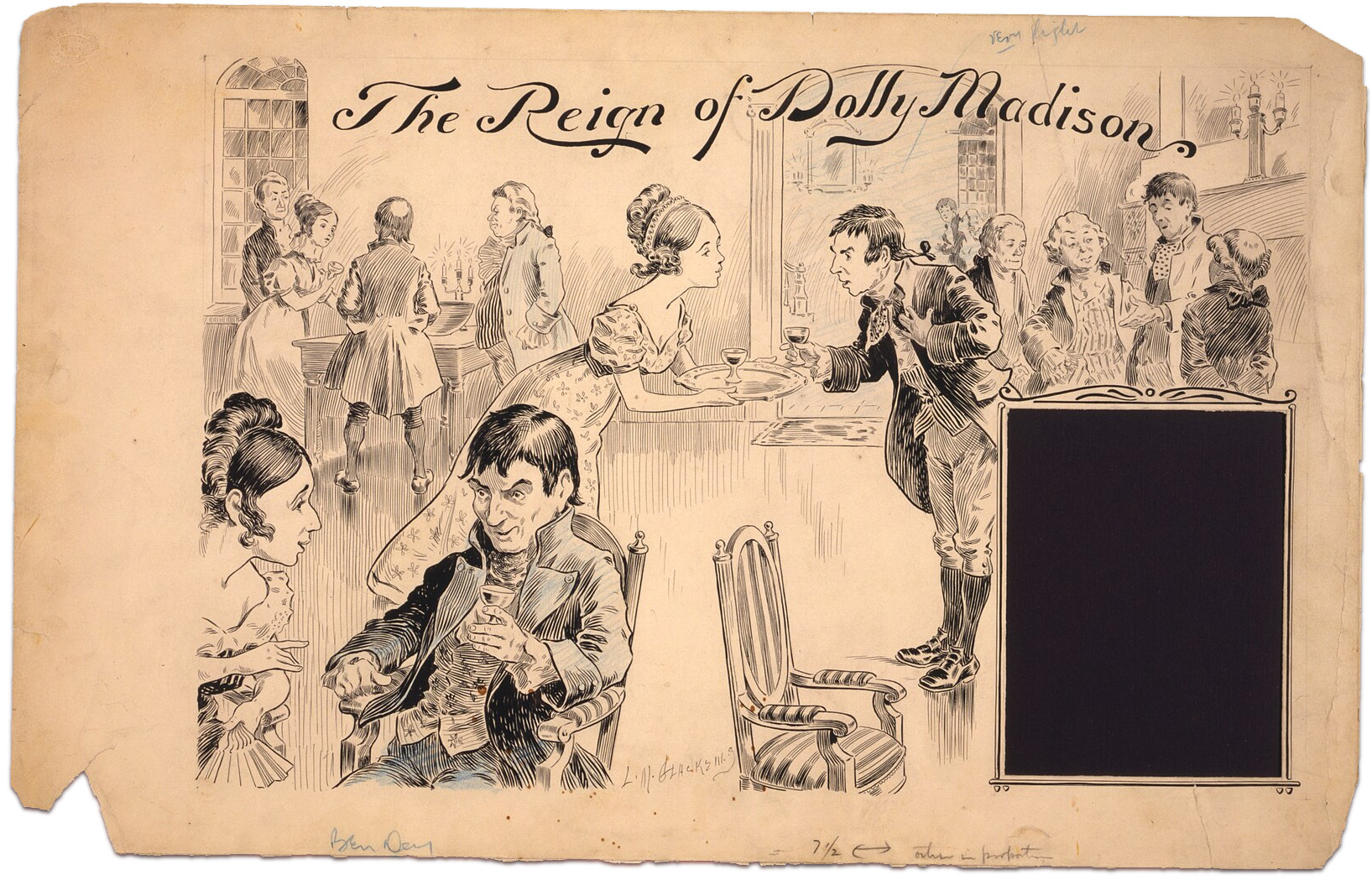
Her most notable innovation was her weekly receptions. They were so popular that attendees called them “squeezes.” Every Wednesday evening, anyone in Washington City was invited to socialize in a freewheeling atmosphere much like a modern cocktail party. At times, up to five hundred people squeezed into Dolley’s dazzling Oval Room. 

In the soft candlelight of “Mrs. Madison’s Wednesday nights,” the tense debates on the floor of Congress melted away. Using the distractions of food, wine, and music, legislators could propose, negotiate, and make deals. Quite quickly, the official men of Washington saw the political opportunities offered by the drawing rooms. For instance, if a politician had a visitor or constituent in town, what better way to impress them than by a visit to meet the president and the famous Dolley?

“The tense debates on the floor of Congress melted away.”

Once a week, anyone in town had access to James Madison. Never before or since has a president been as accessible. But perhaps even more importantly, all the men of the government had access to each other. Consequently, a lot of “meat and potatoes” politicking went on during those Wednesday night festivities, including the gathering and dispensing of information, especially about the prospect of a second war with Great Britain. 

Access and information are the lifeblood of politics. Several categories of political work that happened at the drawing rooms became institutionalized in the two-party system, including patronage and lobbying. Politicians were not the only ones to take advantage of this unofficial opportunity. Anyone seeking a job, looking to promote a project, or presenting a petition for a piece of legislation knew where to go to further their cause.

Part of the power of the squeezes was their regularity: they were an institution. People could count on them as “a place to see and be seen,” as one astute observer put it. These events became so important to the workings of the government that on more than one occasion, Dolley left her sickbed to preside. Even the death of the vice president, George Clinton, did not stop the party. Dolley had created a political center, important to everyone who was anyone. Fittingly, the Executive Mansion acquired a nickname: “the White House.”

The Reign of Dolly Madison | Louis M. Glackens

The “unofficial sphere” of women and social events also served deeper social and psychological purposes. Congressmen might rail at each other in the halls of government, dueling and fighting in the streets, but at Mrs. Madison’s squeezes they had to behave. Consequently, the lawmakers got to know each other as human beings. Women in political families forged social relationships across the aisle and worked together on various charity and patronage projects. It was hard to cast one’s political opponent as the embodiment of evil if you shared a drink with him and if your wives and families socialized with each other regularly. Washington lawmakers began to understand that, even though someone might disagree about a political issue, they could still have the public good at heart. By being in company together on Dolley’s common ground, men could begin to build their own common ground.

Bit by bit, under Dolley Madison’s watchful eye, members of the government began building a ruling class and shoring up what would become a two-party system, a hallmark of our democracy. Before the word, let alone the concept, of bipartisanship entered American politics, Dolley Madison, like a master politician, understood that working together had to be part of the system. These early leaders were learning how to collaborate, how to be prudent rulers when they were in power, and how to be an informed dissenter when they were not. They discovered ways they could foster their own political and party identities without tearing the nation apart. 

These are the skills that would prove to be crucial in later decades when the United States became a modern nation, a power player in the world. By the 1820s, the founding men’s experiment in “pure republicanism” had given way to an American democracy with two parties and a strengthening federal government. That this transition happened smoothly in the new capital city was thanks to Dolley’s efforts to create spaces and opportunities to politic in strikingly modern ways.

The flaw in the founders’ plans was to imagine that political business should take place only in the official sphere. The “official sphere” encompasses political decisions and actions. Official spheres are public; think of press releases and congressional sessions. The unofficial sphere is about the process of politics and is often situated in more private spaces. Serious consideration of Dolley Madison’s efforts demonstrate that the healthiest political system must have a place where politicians can think creatively about political solutions and to see each other as human beings. 

In Pursuit is a landmark initiative of More Perfect, a bipartisan alliance of 43 Presidential Centers, National Archives Foundation, American Academy of Arts and Sciences, Karsh Institute for Democracy at the University of Virginia, and more than 100 organizations working together to protect and renew our democracy as we approach the 250th anniversary of the Declaration of Independence and beyond.

James Madison by Jack Rakove

Process over Perfection.

This essay was first published by In Pursuit, an initiative of More Perfect, a bipartisan alliance of over 43 presidential centers and many of the country’s leading educational and civic initiatives. Visit https://inpursuit.substack.com/ to learn more about the project.

James Madison is often described as the Father of the Constitution. Yet it is hard to make any individual the father of a document that took months to write, with multiple framers and several important committees contributing to its composition. Nor would Madison have thought of himself as the main author of the Constitution. The Federal Convention rejected several of the proposals he worked hardest to attain. Some of its key decisions sorely disappointed him, especially the narrow vote to give each state equal weight in the Senate. Madison knew how different the constitution-makers of the American revolutionary era were from the heroic individual lawgivers of antiquity: Solon of Athens, Lycurgus of Sparta, even (perhaps) Moses of Sinai.

Yet it is also true that no one played a more important role than Madison in facilitating and securing the adoption of the Constitution. He was involved in nearly every aspect of developing a national constitution, beginning with the steps that led to the ratification of the Articles of Confederation in 1781 and later efforts to amend it. He was one of the dozen commissioners who attended the futile Annapolis Convention of 1786, and the one who worked hardest to implement its recommendation that a general convention to revise the Confederation should assemble at Philadelphia in May 1787. His intellectual preparations deeply shaped the Virginia Plan that Governor Edmund Randolph introduced when the Convention opened and which set the framework for its deliberations. 

Drawing on his experience in the Continental Congress and the Virginia assembly, Madison concluded that the federal union could no longer rely upon the state legislatures to implement its decisions. The Virginia Plan accordingly proposed the formation of a new government that could enact, execute, and adjudicate its own laws, which would thus require establishing an independent legislature, executive, and judiciary. Madison also thought deeply about how the Constitution, once drafted, would be ratified. After eleven states had done so by July 1788, he took the dominant role in ensuring that the First Congress would consider the amendments that the state conventions had proposed. Without his forceful leadership, the Bill of Rights might never have been added to the Constitution.

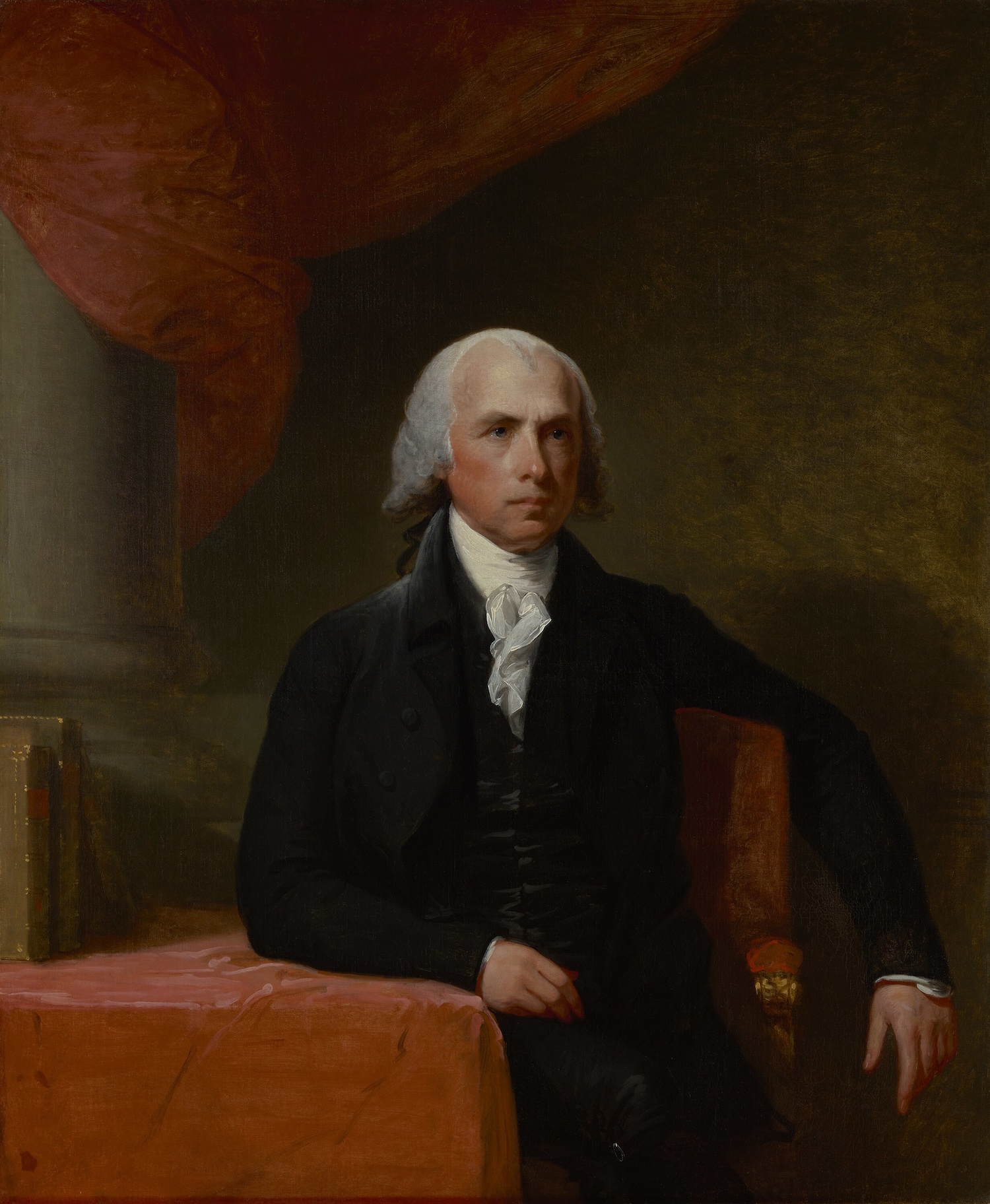
Portrait of James Madison | Gilbert Stuart
‍

Rather than thinking of Madison as the father of the Constitution or even its main author, then, it is far more useful to regard him as the leading strategist of constitutional reform. His genius lay in recognizing that it was less important to design a perfect model of government than to ensure that the American people would agree that the entire process of adopting a new constitution had been properly conducted. That central insight—process over perfection—guided the Federalist supporters of the Constitution during the eleven months needed to secure its ratification.

Four main points demonstrate how Madison, as a genuine pioneer of constitutional statesmanship, sought to shape a process that the American people would deem legitimate.

First, Madison learned crucial lessons from his sustained service in the Continental Congress and the Virginia House of Delegates. That experience made him a keen observer of how deliberative bodies functioned and, more to the point, the advantages that a skillful and well-prepared leader could gain by shaping the agenda of debate. With the other delegations arriving late to Philadelphia, the timely Virginians and the host Pennsylvanians took the opportunity to present as ambitious a proposal for a new national government as anyone could have imagined.

“No one played a more important role than Madison in facilitating and securing the adoption of the Constitution.”

Second, Madison became preoccupied with the need to find a clear method for distinguishing the status of ordinary statutes from the supremacy of a written constitution. Because one legislature could not bind its successors, a constitution ratified in that way could be violated or even revoked by a later meeting of the same body. To make the proposed Constitution the “supreme law of the land,” therefore, its ratification had to rest upon a clear and unequivocal affirmation by “we the people” themselves, through specially organized conventions serving for that sole purpose. And the people’s delegates, once assembled, could say only one of two words—either “yes” or “no”—to the whole Constitution. The state conventions could freely recommend amendments for future consideration. But they could not make their vote contingent on their prior approval.

Third, Madison realized that it was essential to prevent ongoing rounds of discussion from introducing new complications in the text of the Constitution. Madison’s colleague and friend Edmund Randolph was one of three delegates who refused to sign the Constitution on September 17, 1787, believing that a second convention should be held to take into account the results of the popular debate that was about to begin. Madison thought, correctly, that such a step could become a political disaster. The fact that no prior plan of a constitution had been circulating before the Virginia Plan was drafted had proved a great advantage to the Convention. If a second convention were held, many of the delegations could well return to Philadelphia encumbered with explicit instructions on potentially controversial matters. The public debate over ratification had to be open so that competing views and sensible criticisms could be aired and discussed. But at some point, and sooner rather than later, it would have to end. Randolph’s pet proposal for a second convention could produce the opposite result.

Fourth, to achieve a political consensus across the citizenry as a whole, Madison strove to accommodate the reasonable demands of the Constitution’s well-meaning if somewhat misguided opponents, the Anti-Federalists—but without jeopardizing crucial points that the framers had worked hard to achieve. That was why Madison toiled, in the spring of 1789, to winnow all the amendments that the state conventions had proposed into a tidy list limited primarily to the protection of rights. Madison himself remained unconvinced that the addition of a bill of rights was necessary. He worried about what would happen to rights that were not included and also about the problem of ensuring that the rights listed were properly defined and stated. But he saw no other way to bring the entire process of constitutional adoption to an appropriate close. Strange as it may seem to us now, the great achievement of the Bill of Rights was not to secure the liberties of the people by constitutional amendment. Only in the twentieth century did the Bill of Rights gain an important place in our constitutional jurisprudence. Its still greater achievement was that, after 1789, both Federalists and Anti-Federalists agreed that the Constitution was legitimately the supreme law of the land.

The Bill of Rights
‍

Madison’s skillful shepherding of ratification, through the remarkable deliberations of 1787-1789, yielded a political experiment unprecedented in nature and scope: the creation of the American constitutional republic. The lessons of this period are all the more impressive if one considers how daunting a prospect any serious effort at constitutional reform would face today. Our current constitutional system is in crisis; by some measures, it is actually failing. Trying to imagine how it could be reformed now staggers our political imagination.

Here, too, Madison offers one final insight. In Federalist 49, he reminded his readers what a difficult task creating a constitution could be. Americans should recall, he wrote, how many favorable factors had been in play when the revolutionaries of 1776 began writing new state constitutions as they were declaring independence from Britain. They could not confidently expect such a fortunate situation to prevail later. These “experiments are of too ticklish a nature to be unnecessarily multiplied,” he warned. At a moment when our Constitution badly needs strengthening or even revision, Madison’s warning underscores how lucky our young nation was to have such a masterful constitutional strategist at the helm—and how desperately those talents are still needed.

In Pursuit is a landmark initiative of More Perfect, a bipartisan alliance of 43 Presidential Centers, National Archives Foundation, American Academy of Arts and Sciences, Karsh Institute for Democracy at the University of Virginia, and more than 100 organizations working together to protect and renew our democracy as we approach the 250th anniversary of the Declaration of Independence and beyond.

Thomas Jefferson by Andrew M. Davenport

Dream of the Future

This essay was first published by In Pursuit, an initiative of More Perfect, a bipartisan alliance of over 43 presidential centers and many of the country’s leading educational and civic initiatives. Visit https://inpursuit.substack.com/ to learn more about the project.

Thomas Jefferson described himself as “deeply practiced in the school of affliction.” He mourned the early deaths of his father, his wife, and several children. “The human heart knows no joy which I have not lost,” he wrote, “no sorrow of which I have not drunk! Fortune can present no grief of unknown form to me.”

Jefferson also experienced profound challenges as a public figure. He faced the wrath of the British empire and the insults and scandalmongering of his political opponents. When he reflected on his shortcomings, he saw a man—though a forceful, lifelong critic of slavery—who was too dependent upon the institution and too skeptical of Black equality to become a public advocate of abolition.

And yet, despite—or perhaps because of—his inability to solve many problems of the present, Jefferson placed his faith in the future. “I like the dreams of the future better than the history of the past,” he told John Adams in 1816.

Thanks for reading! Subscribe for free to receive new posts from In Pursuit each week.

Jefferson may have penned and aspired to the revolutionary ideals of the Declaration of Independence, but he trusted later generations to realize them fully. He understood that the citizen leaders of a democratic republic must breathe life into their nation through the practice of hope, optimism, and reason.

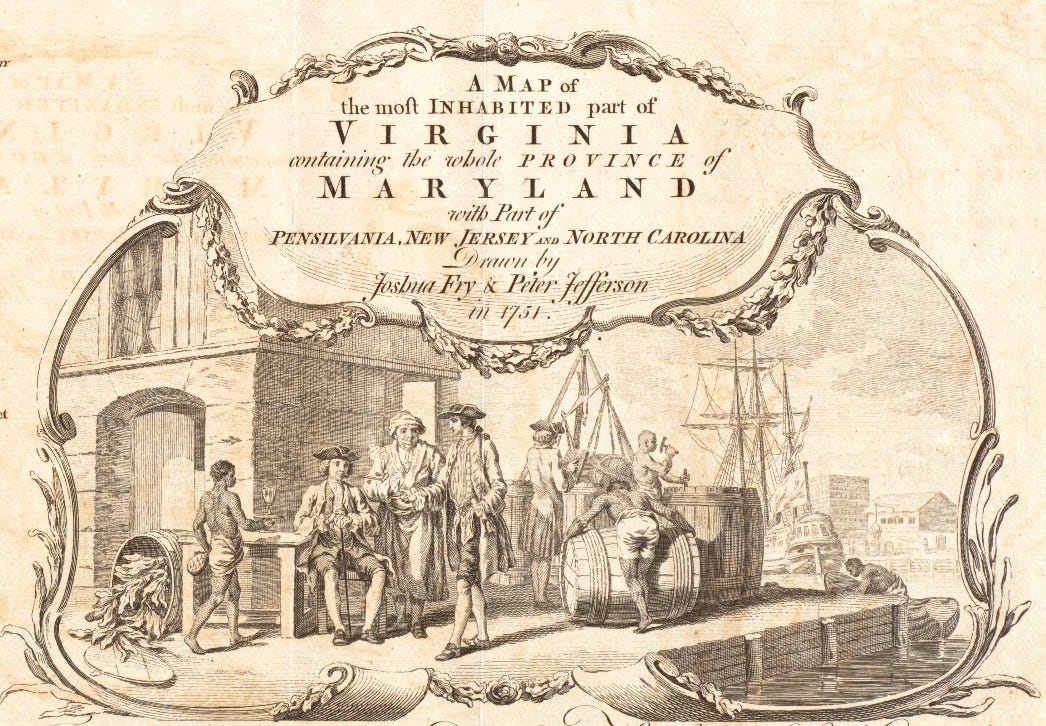
Born in 1743, on what was then the western frontier of British North America, Jefferson was a privileged member of the Virginia aristocracy. His father, Peter Jefferson, was a loyal subject of the British empire, an upwardly-mobile planter and surveyor before his death at the age of forty-nine. The elder Jefferson left behind a wife, eight children, and an estate of several thousand acres—along with dozens of slaves.

Detail of Joshua Fry, Peter Jefferson, Robert Sayer, and Thomas Jefferys. “A map of the most inhabited part of Virginia containing the whole province of Maryland with part of Pensilvania, New Jersey and North Carolina,” (1768). Norman B. Leventhal Map & Education Center.

His son Thomas split the inheritance with his younger brother, receiving an unparalleled education at the College of William & Mary in Williamsburg before training as a lawyer. Like his fellow revolutionary George Washington, Jefferson made an advantageous marriage to a wealthy widow. From Monticello, the mountaintop home he designed and situated above his plantations, Jefferson vaulted into Virginia’s elite.

In the years before the Revolutionary War, Virginia’s homegrown political leaders chafed at Britain’s interference in their daily lives. They resented Westminster’s efforts to curb their control over local affairs. They bristled at the sudden imposition of taxes collected straight from their pockets. And they bemoaned new limits on their push westward into Native territories.

Initially, Jefferson trusted the empire to respond to the colonists’ pressure and reform itself. It was not to be. When King George III and his ministers escalated their campaign against the colonies, Jefferson and other patriot leaders pledged their lives, their fortunes, and their sacred honor to the common cause of American independence.

For the Declaration’s signatories, putting their names on that landmark document could very well have meant death; for the new nation they contemplated, it meant life. Despite the risks, Jefferson and the other founders of the United States believed in the blessings that a new, self-governing nation could bestow on posterity.

During the war to bring about that independence, Jefferson was torn between his duties to his new nation and to his family. The cumulative stresses of Jefferson’s wartime service as governor of Virginia and the birth of six children in ten years contributed to the early death of his wife, Martha Wayles Skelton Jefferson, at age 33. By all accounts, their marriage had been a happy one. After her death, an inconsolable Jefferson contemplated suicide. With the support of his friends, Jefferson overcame his grief to serve his country as a minister to France, charged with safeguarding the interests of the fledgling United States.

After Jefferson’s return from Paris in 1789, his future-oriented perspective helped him be appointed or elected Secretary of State, Vice President, and, ultimately, President of the United States. Despite Washington’s warning against “the baneful effects of the spirit of party,” Jefferson’s tenure in national politics coincided with the rise of intense partisanship. Jefferson himself sowed some of the seeds of division. He reacted viscerally against Federalist plans for a centralized government fueled by manufacturing and trade; even while serving in the Federalist administrations of George Washington and John Adams, he deliberately undermined aspects of their agenda.

A political philosopher and natural scientist, Jefferson imagined an ever-expanding agricultural republic—a nation of innovation and experimentation, populated by yeoman farmers. He once reflected that “[n]ature intended me for the tranquil pursuits of science, by rendering them my supreme delight. But the enormities of the times in which I have lived, have forced me to take a part in resisting them, and to commit myself on the boisterous ocean of political passions.” Science and politics were not so mutually exclusive, however. Jefferson became a leading member of the American Philosophical Society, calling his election as its president “the most flattering incident of my life” up to that point. He believed the future of the nation rested on continuous advancements in knowledge of the natural environment.

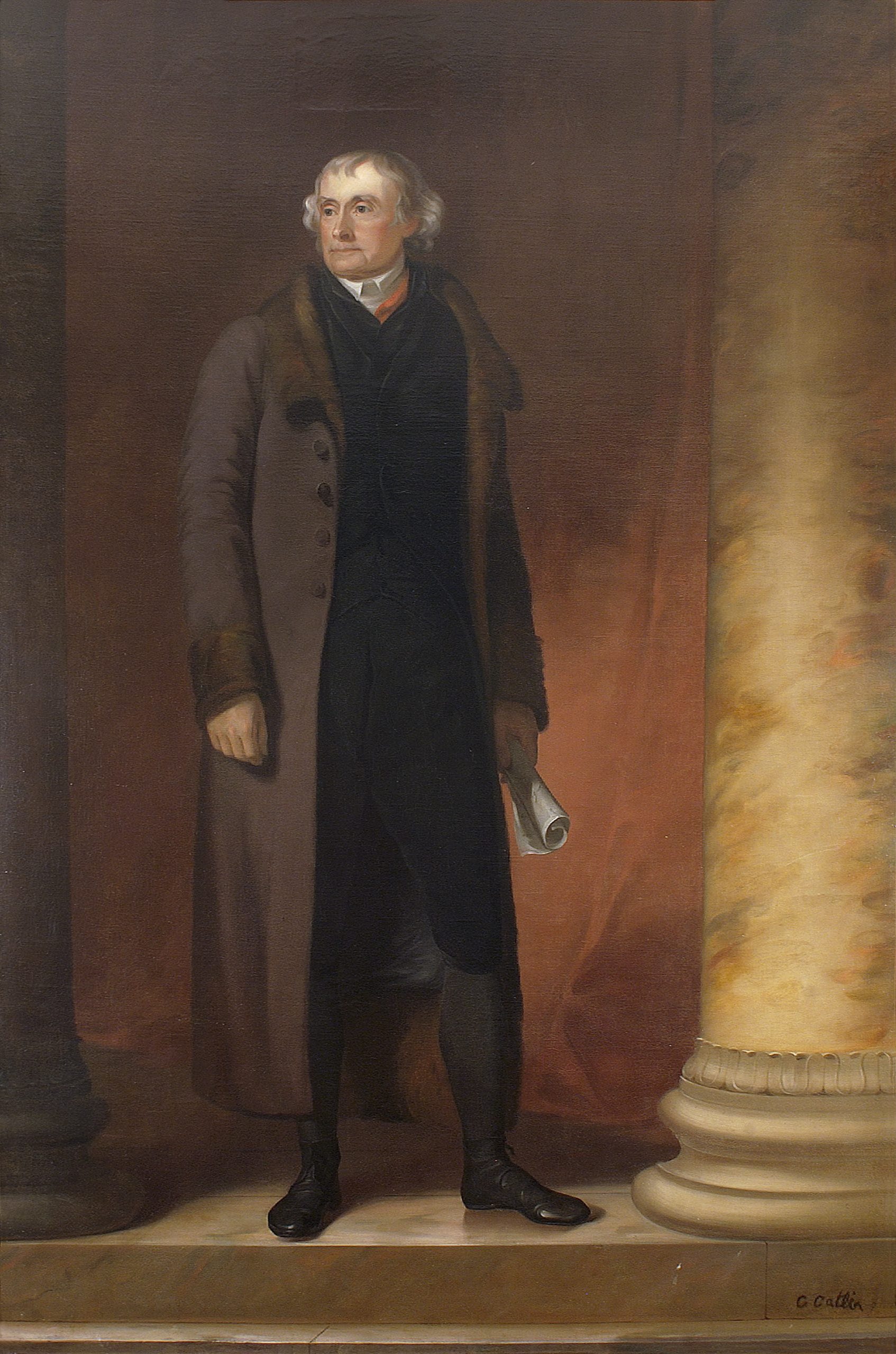
George Catlin after Thomas Sully, Portrait of Thomas Jefferson, ca. 1827. State Art Collection, Library of Virginia.

Jefferson’s wager on the future contained a rather glaring loophole. It enabled him to entrust his day’s thorniest challenge—emancipation—to subsequent generations. He considered the American Revolution to be his generation’s lasting contribution, leaving abolition to those who would follow. In Jefferson’s reckoning, the United States was not prepared for the end of slavery. Limited by self-interest, financial pressures, and the law, Jefferson could not—as Washington did—free the human beings he enslaved en masse. Of the more than 600 people he held in bondage during his lifetime, he freed only ten or so, including his four surviving children with his enslaved chambermaid, Sally Hemings. Still, Jefferson’s aspirational words in the Declaration of Independence inspired countless African Americans and their allies to realize the multiracial republic Jefferson and so many of his peers could not envision.

Jefferson’s republican principles rested on a foundation of faith in his fellow citizens. Rather than merely trust others to carry forward his vision, in retirement Jefferson founded the University of Virginia to help instill those republican values in the youth of his young nation. “I am closing the last scenes of life by fashioning and fostering an establishment for the instruction of those who are to come after us,” he wrote. “I hope its influence on their virtue, freedom, fame, and happiness, will be salutary and permanent.”

Jefferson gave much to the United States: the ideals of self-government, freedom of conscience, and freedom of mind—not to mention his personal library, whose volumes helped reconstitute the Library of Congress after the British put it to the torch during the War of 1812. In the mass of Jefferson’s contradictions, his faith in the future is his most enduring characteristic—a deliberately and carefully cultivated outlook on life that undergirds the American experiment that Jefferson wrote into being.

More than a century after Jefferson’s death, President Franklin D. Roosevelt—an admirer of the Sage of Monticello—encouraged the U.S. Mint to engrave our nation’s third president on the nickel. Stamped with Jefferson’s stoic profile, the currency was passed hand to hand through the restless, inventive republic he’d championed. Shortly after the turn of the new millennium, the U.S. Mint updated the design of the coin. Jefferson’s visage now faced resolutely forward.

Andrew M. Davenport, Ph.D., is Vice President for Research and Saunders Director of the Robert H. Smith International Center for Jefferson Studies at Monticello.

In Pursuit is a landmark initiative of More Perfect, a bipartisan alliance of 43 Presidential Centers, National Archives Foundation, American Academy of Arts and Sciences, Karsh Institute for Democracy at the University of Virginia, and more than 100 organizations working together to protect and renew our democracy as we approach the 250th anniversary of the Declaration of Independence and beyond.

Abigail Adams by Joseph J. Ellis

Courageous and frank communication can echo across history and inspire change long before the world is ready to accept it

This essay was first published by In Pursuit, an initiative of More Perfect, a bipartisan alliance of over 43 presidential centers and many of the country’s leading educational and civic initiatives. Visit https://inpursuit.substack.com/ to learn more about the project.

In eighteenth-century America, distance still made a huge difference. There were no cellphones, no internet, no instant forms of communication. There were, however, letters, which often took weeks or months to arrive. The act of writing a letter was therefore a more deliberative process than composing an email, more like writing a speech than having a chat, more a projection of your deepest thoughts than your immediate impulses.

This distinction between now and then is essential background as we enter their lost world and attempt to grasp the full meaning of the roughly 1,200 letters that John and Abigail Adams exchanged during the founding era. For, in truth, they were writing to us as well as to each other.

Our story begins in June of 1776, when John wrote these words to Abigail: “I have now purchased a Folio Book in the first page of which…I am writing this letter, and intend to write all my letters to you in it, from this time forward.” He urged Abigail to do the same thing, claiming that “I really think that your letters are much better…than mine.” (Many historians have tended to agree with John’s judgment.)

When John wrote these words, he presumed that he and Abigail were crossing the Rubicon together, living through the decisive moment in American history and they had both an opportunity and obligation to record their thoughts for future generations, which is to say us.

On one score John was right. He and Abigail both believed that American independence was inevitable. But, as he already knew, they were not on the same page when it came to the political agenda of an independent America. A letter that Abigail began writing a few months earlier in March made that clear. When John received her letter in early April, he found what he called “my saucy wife” lived up to her reputation.

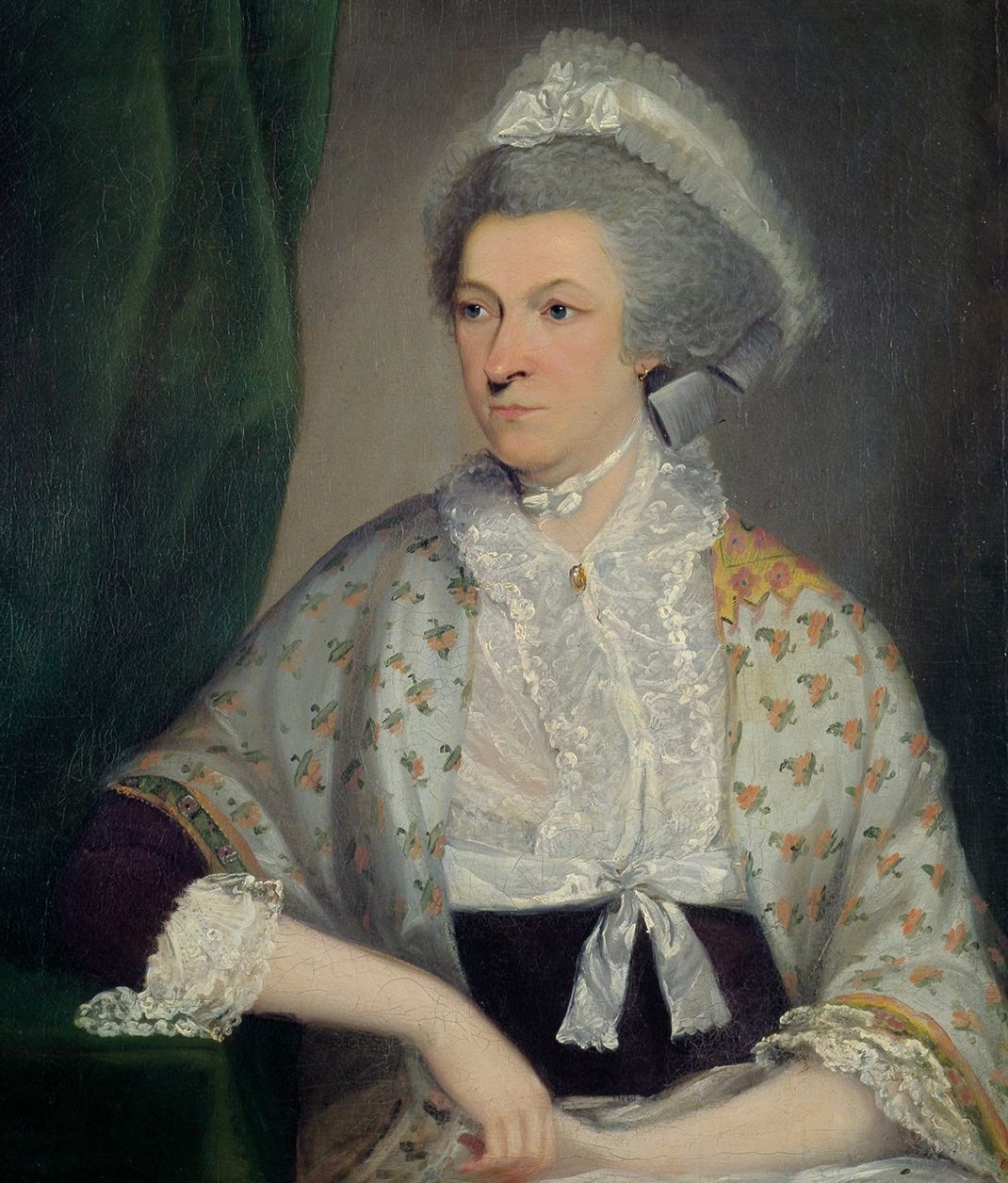
Ralph Earl, Abigail Adams. Oil on canvas, c. 1795. Collection of the Fenimore Art Museum. Bequest from the Estate of Francis J. Eggleston.

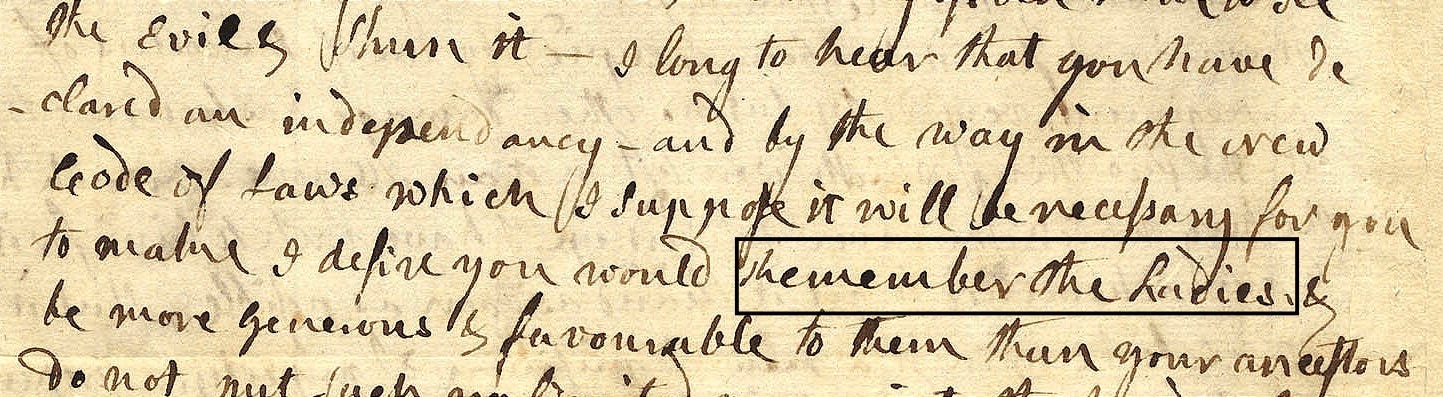
“And, by the way,” she began, in what has become the most famous letter in the entire Adams correspondence, “in the new Code of Laws which I suppose it will be necessary for you to make I desire you would Remember the Ladies, and be more generous and favourable to them than your ancestors. Do not put such unlimited power into the hands of the Husbands. Remember all Men would be tyrants if they could. If particular care and attention is not paid to the Ladies we are determined to foment a Rebellion, and will not hold ourselves bound by any Laws in which we have no voice or Representation.”

John bantered back, claiming “as to your extraordinary Code of Laws, I cannot but laugh,” adding that he had no desire to exchange, what he called the tyranny of George III for “the despotism of the petticoat.”

Abigail never wavered. First, she threatened that she and her closest friend, Mercy Otis Warren, intended to file a petition in the Boston press, claiming that they were being taxed without their consent. Then she embraced her own “sauciness” and delivered her ultimate threat. “But you must remember that Arbitrary power is like most things which are very hard…and notwithstanding all your wise Laws and Maxims we have it in our power, not only to free ourselves, but to subdue our Masters, and without violence throw both your natural and legal authority at our feet.”

Detail from Abigail Adams to John Adams, 31 March – 5 April 1776. Collection of the Massachusetts Historical Society.

She was not only arguing that women had the right to vote, but also that all presumptions of male supremacy (i.e. patriarchy) needed to die a natural death. Both arguments were far ahead of their time. White women did not get the vote in national elections until 1920. As for patriarchy, though on the political defensive in most blue states, it is still alive and well in significant segments of the male population.

What do you do if you are a highly intelligent New England woman with ardent political convictions about gender equality that you realize will never come into existence during your lifetime, or even for your female descendants? This was Abigail’s dilemma. From the perspective of outspoken feminists now, the answer to the dilemma is clear. Abigail had the opportunity to become the leader of the feminist movement in America, this before the word “feminism” had yet to appear in the dictionary.

That option never occurred to Abigail. She inhabited an eighteenth-century world in which her deepest sense of fulfillment came from performing her role as a wife and mother. Even the extraordinary statement of women’s rights came in a private letter to John, her wifely duty to make him more aware of the full implications of America’s revolutionary agenda. She threatened to go public with her convictions, but never did.

She was, to be sure, a visionary, but the vision she kept in her mind’s eye throughout her life was those moments when she and John were holding hands while walking through their field at Braintree, the four children training behind. Her only daughter, called Nabby, was groomed to become a homeschooled wife and mother. Her sons were groomed for college at Harvard.

But even in her preferred and private role as a wife, she could be disconcertingly formidable. Thomas Jefferson, who lived with the Adams family for several weeks in Paris, was taken aback by her ability to recite passages from Shakespeare while cooking supper, or apprise him of the political factions within the French court. No southern woman he had ever met could do that. During the Adams presidency, whenever John made an unpopular decision, the preferred explanation was often that his wiser, more politically savvy wife was not there to advise him. No first lady until Eleanor Roosevelt exercised more political influence on her husband.

More immediately, as we begin to celebrate the 250th anniversary of American independence, no person left a clearer statement in the written record that sexual equality was a significant legacy of the American Revolution. Because the Adams correspondence was so carefully preserved, Abigail’s visionary legacy still speaks to us. And it remains visionary.

Joseph J. Ellis, Ph.D., is Professor Emeritus of History at Mount Holyoke College.

In Pursuit is a landmark initiative of More Perfect, a bipartisan alliance of 43 Presidential Centers, National Archives Foundation, American Academy of Arts and Sciences, Karsh Institute for Democracy at the University of Virginia, and more than 100 organizations working together to protect and renew our democracy as we approach the 250th anniversary of the Declaration of Independence and beyond.

John Adams by Danielle Allen

Great leaders succeed by choosing who else leads

This essay was first published by In Pursuit, an initiative of More Perfect, a bipartisan alliance of over 43 presidential centers and many of the country’s leading educational and civic initiatives. Visit https://inpursuit.substack.com/ to learn more about the project.

John Adams—the “Colossus of Independence”—was an acclaimed politician, lawyer, writer, and constitutional thinker. He started life as a bookish young man on a family farm in Braintree, Massachusetts, where his father was a deacon in the Congregational Church. Fiercely loyal to the cause of America, Adams would go on to serve as Massachusetts’s delegate to the Continental Congress during the American Revolution, negotiator of the treaty to end the War of Independence, the first U.S. ambassador to the United Kingdom, the first Vice President, and the second President of the United States.

Yet for all his impressive accolades, Adams arguably made his greatest impact through his choices of whom to place in positions of leadership and influence. In his years as a young lawyer in Boston, Adams developed the practice of writing down character studies of people he encountered. Independent-minded and cantankerous, he was nonetheless an exemplary judge of character and unafraid to delegate to those he deemed worthy. Beginning with the very creation of the new nation, Adams’ most significant achievements came from empowering others.

Since the fall of 1775, Adams—along with the Virginian Richard Henry Lee—had been pushing Congress to issue a declaration of independence from Britain. In June 1776, Congress decided to set up a committee to draft the declaration’s preamble. Many people would have jumped at the chance to articulate the principles that would define the American experiment. Instead, Adams ensured that Thomas Jefferson would be appointed head of the five-person drafting committee.

Why? It’s true Adams was one of the busiest members of Congress, ultimately serving on ninety different committees. His real reasons, though, went beyond workload. As Adams claimed to have put it in a conversation with Jefferson:

Reason 1st. You are a Virginian and a Virginian ought to appear at the head of this business.

Reason 2nd. I am obnoxious, suspected and unpopular; you are very much otherwise.

Reason 3rd. You can write ten times better than I can.

Putting aside ego, Adams selected the man he believed would best articulate the moral case for the nation—a case that Lincoln would pick up and reinvigorate four-score and seven years later.

Adams’ clear-eyed assessment of others likewise enabled the American Revolution to conclude on satisfactory terms. In 1782, Congress dispatched to Paris three American peace commissioners—Adams, the wealthy New Yorker John Jay, and the scientist-politician Benjamin Franklin—and charged them with keeping their French allies fully informed of all conversations with the British.

The French skillfully used this inside information to steer negotiations toward their own interests, even where those diverged from America’s. Franklin had been in Paris since December 1776. His wit and sociability made him a darling of French society, and he was on intimate terms with the French negotiators. As Jay and Adams saw it, Franklin’s social entanglements were making action on behalf of America difficult. Despite his protestations, Franklin had real conflicts of interest.

On October 29, 1782, Jay and Franklin argued about how to continue the negotiations with France and Britain. Jay proposed a different method and manner than Franklin’s relaxed approach. The commissioners, as Adams put it, needed “to be honest and grateful to our allies, but to think for ourselves.” Adams endorsed Jay’s proposal that they should start negotiating with the British without informing the French.

Benjamin West, American Commissioners of the Preliminary Peace Negotiations with Great Britain. Oil on canvas, 1783-1820. Winterthur Museum, Garden, & Library, Gift of Henry Francis du Pont.

Outvoted, Franklin concurred. The three men delivered the preliminary articles of peace a month later, on November 30, 1782, after a full year of failed negotiations. It was Adams’ clarity about the character of those around him that enabled this breakthrough and put negotiations on a new path that finally led to peace.

As president, too, Adams’ choice of personnel was a key to his success. Beginning in 1797, Adams’ tenure was defined by the challenge of navigating conflict with France. An important ally during the Revolutionary War, France had by this time overthrown its monarchy, descended into brutal violence, and plunged into war with Great Britain, Austria, Prussia, and Russia.

George Washington, Adams’ predecessor and the nation’s first president, had established that the United States would remain neutral in the conflict. Believing a standing military to be a threat to liberty, Congress had even disbanded the Revolutionary navy and army. After Washington concluded his two terms and returned to his Mount Vernon home, though, the country’s emerging political factions kicked against the neutrality decision. The Federalists, led for all practical purposes by Alexander Hamilton, wanted to ally with Britain and restore the French royal family—with many supporting a larger and more assertive American military. The Republicans, led by Thomas Jefferson, advocated defending the new French Republic but remained deeply concerned that a strengthened military jeopardized the underpinnings of the American republic and risked domestic coercion.

Gilbert Stuart, John Adams, oil on canvas, c. 1800/1815). National Gallery of Art, Gift of Mrs. Robert Homans.

The actions of the French worsened matters. Frustrated by American neutrality and the American refusal to repay to the French Republic debts incurred earlier to the King, the French began attacking and capturing American merchant ships. From October 1796 to June 1797, they seized some 300 vessels—about 6 percent of the entire U.S. merchant fleet.

Adams knew French aggression had to be stopped, but was also keenly aware of the danger of being dragged into a larger European conflict while the nation was still fragile and underdeveloped. Threading the needle between factions, Adams sought Congressional authorization for a military call-up and a naval force—intending to put both to work to enforce neutrality. He sought strength without entering the war.

The canny New Englander faced the daunting challenge of how to help his fledgling nation learn to wield military tools without militarizing as a society—the Republicans’ great fear. Adams assuredly made mistakes—deciding to sign rather than veto the Alien and Sedition Acts, for instance, which permitted the government to prosecute Americans for speaking and publishing criticism of their leaders. Yet he mostly succeeded, once again, by installing the right people. He put George Washington back at the head of the army and Benjamin Stoddert—a resourceful and forward-thinking merchant and former Continental Army officer—at the head of the navy. Both men were characterized by impeccable personal self-discipline and respect for institutions. These choices ensured that the military build-up would be targeted and constrained, and that the country would accept a reduced military role after the end of the conflict.

In many ways, Adams’ most important judgment call was his earliest. On October 25, 1764, Adams had married the slender, serious, brown-eyed Abigail Smith, a woman of great intelligence, candor, and political attunement who matched him in love of learning. Over fifty-four years of marriage, they developed shared moral commitments—for instance, their rejection of slavery—through conversations and exchanges of letters. This long-running conversation with Abigail equipped Adams with a navigational compass as he led his fellow colonists toward Independence, through constitution writing, into a restored relationship with Britain, and onto a new political footing. The strength of their relationship enabled Adams—and the nation—to flourish.

After arriving at the “President’s House” on November 1, 1800—the first chief executive to inhabit the soon-to-be iconic White House—Adams penned to his cherished Abigail the exhortation that would one day be carved into the fireplace of the State Dining Room: “May none but honest and wise Men ever rule under this roof.”

That prayer called future generations to revere good character. Adams’ own ability to identify and empower honest and wise Men—and Women—played an essential role in shaping the trajectory of our young nation.

Danielle Allen, Ph.D., is the James Bryant Conant University Professor at Harvard University, the Director of the Allen Lab for Democracy Renovation at the Harvard Kennedy School, and Director of the Democratic Knowledge Project.

In Pursuit is a landmark initiative of More Perfect, a bipartisan alliance of 43 Presidential Centers, National Archives Foundation, American Academy of Arts and Sciences, Karsh Institute for Democracy at the University of Virginia, and more than 100 organizations working together to protect and renew our democracy as we approach the 250th anniversary of the Declaration of Independence and beyond.


Martha Washington by Karin Wulf

Before women could hold office, she created one

This essay was first published by In Pursuit, an initiative of More Perfect, a bipartisan alliance of over 43 presidential centers and many of the country’s leading educational and civic initiatives. Visit https://inpursuit.substack.com/ to learn more about the project.

Martha Washington had not intended to be the first of anything, but rather to follow in the pattern of the women she knew as wives, mothers, and Virginia plantation mistresses. Instead, she was the first of a long line of women who never sought the role that she inaugurated. While the term “First Lady” was not regularly used for a century after her service, she felt the weight of its responsibility and the eyes of the new nation upon her.

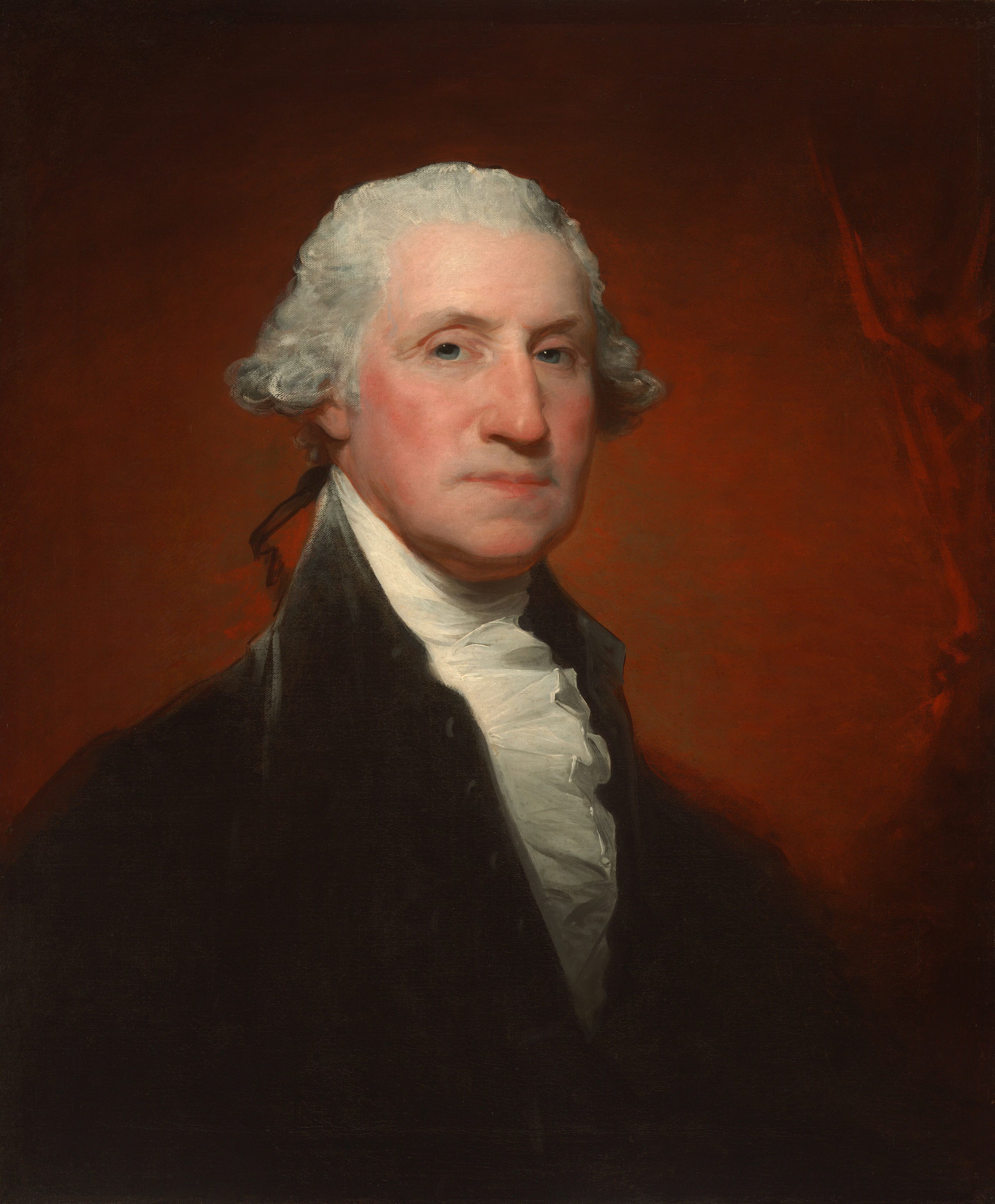
Martha Washington (1731–1802), First Lady of the United States. Oil on canvas, unknown artist (copy after Gilbert Stuart), early–mid 19th century. National Portrait Gallery, Smithsonian Institution

Historians despair of Martha’s decision to burn her correspondence with her famous husband just before she died, yet this First Lady is not unknowable. Like her husband, she has become somewhat calcified in American memory, but the historical record, including her correspondence with friends, family, and associates from her life in Virginia and then as First Lady and her later years, reveals a firm, lively person. She could be direct, astute about politics, and attuned to fashionable clothes and household furnishing – sometimes all in one letter. Portraits made during her life capture only a glimpse of the latter. She ordered sparkling purple silk, silver embroidered and sequined high heeled shoes for her wedding, and she never stopped being fond of shoes. As First Lady she dressed somewhat more plainly but her clothing was always of the finest quality.

Martha Dandridge Custis and George Washington were born less than a year apart, in 1731 and 1732; theirs would be her second marriage, his first. It was, by the accounts of those who knew them best, a loving partnership. In a few surviving letters, George refers to her as his “dear Patcy,” and they addressed each other as “My Dearest.” George signed one urgent letter in the summer of 1775 as “Your entire.” They were happiest together at Mount Vernon, ever mindful of what was happening back at home during the long years of the war and the presidency – and of being apart. Devoted to her husband, Martha spent every winter of the war with him wherever he had made camp for the season, including at Valley Forge.

George and Martha Washington were elite, wealthy Virginians through and through. From her first marriage to the much older Daniel Parke Custis, Martha carried into her union with George two children and an extensive estate that included more than eighty enslaved people. They would not have children together, but they would raise hers. At Mount Vernon they oversaw a plantation complex worked by hundreds of enslaved people. Through a combination of inheritance and acquisition, by the time of George’s death his real estate stretched across tens of thousands of acres and included some small industrial concerns. But, of course, their lives would not be confined to Virginia.

Edward Savage, The Washington Family. Oil on canvas, 1789-1796. Andrew W. Mellon Collection, National Gallery of Art

When she married him, Martha would have known that George was set up for public life, which in colonial Virginia was both an opportunity and a responsibility for elites. The first hint of that came before they married, when he served as an officer in the Virginia militia during the Seven Years’ War. Then shortly after they married George was elected to Virginia’s colonial assembly, the House of Burgesses, where he would serve until the eve of the American Revolution including working closely with the royal governor, Lord Dunmore. Up to that point, Martha’s life as his wife would have seemed a familiar echo of the women among her family and friends. But when her husband’s military leadership of the Revolutionary War and then political leadership of the new United States was required, Martha’s life changed along with those of everyone around her. In the transition from colonies to nation, their friend, the historian and writer Mercy Otis Warren said, “events have outrun [our] imagination.”

The Washingtons lived in three different “presidential mansions” as the capitol city moved, the first two in New York and then the third in Philadelphia through the end of the president’s second term in early 1797. These pre-Washington, D.C. and pre-White House residences have all since been demolished. Glimpses of the Washingtons’ efforts to create a new standard for a presidential life and for the First Lady’s role come through, though. George Washington held a regular formal reception on Tuesday afternoons for men, and Martha held a less formal one, ostensibly for ladies but in fact men and women both attended, on Friday evenings. They called these gatherings “levees,” the name for formal public access to the French monarch; features of the Washingtons’ levees included Martha greeting people from a raised dais (to be fair, she was petite at only 5 feet tall), which raised eyebrows and some critical commentary. How was this democratic?

Yet how was one to be a First Lady – or for that matter, a president – when there had never been such a thing? Borrowing some ceremonial features from the system they knew best, tempered by the sentiments of the revolution, seemed sensible. Martha would hold “the first rank in the United States,” and what she did or said, where she went and what she wore all made for political fodder. The Washingtons would step carefully but decisively, together, into this phase of their “public life.”

It was not without cost. Using the same metaphor that her husband often invoked, Martha wrote of longing to be in “the shades of mount Vernon, under our own vines and fig tree.” And “yet I cannot blame him,” she wrote, “for having acted according to his ideas of duty in obeying the voice of his country.”

For Martha, having been raised to hostess duties, managing the accoutrements of hospitality for diplomats, politicians, office seekers and the general curious public was second nature. She stocked the official residences with such supplies as china decorated with all of the states around the rim of the plates and her own initials in the middle, cutlery, wine, and more prosaic items like “mops and Clamps for scouring brushes.” They acquired printed invitations to dine (“The President of the United States and Mrs. Washington, request the Pleasure…”) which could be filled in with the names of the lucky invitees. Martha described both formal and less formal visits: “the practice with me has been always to receive the first visits, and then to return them”; these included “the ladies of the diplomatic corps…introduced in their first visits by the Secretary of State.”

 In this innovation, borrowing from traditions, Martha Washington did something no American woman had ever done: she occupied an entirely new national role, and she taught the country how to see a woman in it.

Did she encourage her husband’s better angels? In one respect we know she emphatically did not. She was casually cruel about slavery and her expectations of enslaved people. Confounded when seventeen fled with the British, who were promising freedom during the revolution, she was infuriated when one of her maids fled from Philadelphia decades later and wanted her tracked down and then brought back (she never was). But did he encourage hers? Perhaps. When he died George Washington provided that at Martha’s death the enslaved people he owned would be emancipated, but for whatever reasons, possibly out of fear, she acted on that provision just a year after he died and a year before she followed him to the grave.

Martha Washington would prove a hard act to follow.  Before women could hold office, she had to create one by stepping onto the center stage of American public life without a script and making her role real through practice. At the end of Washington’s presidential administration, Abigail Adams wrote to the only woman to serve in the position she was about to hold that she would “endeavor to follow your steps and by that means hope I Shall not essentially fall Short.”

Karin Wulf, Ph.D. is the Beatrice and Julio Mario Santo Domingo Director and Librarian of the John Carter Brown Library, and Professor of History at Brown University.

In Pursuit is a landmark initiative of More Perfect, a bipartisan alliance of 43 Presidential Centers, National Archives Foundation, American Academy of Arts and Sciences, Karsh Institute for Democracy at the University of Virginia, and more than 100 organizations working together to protect and renew our democracy as we approach the 250th anniversary of the Declaration of Independence and beyond.

President George Washington by President George W. Bush

For a Leader, Humility is the Ultimate Strength

This essay was first published by In Pursuit, an initiative of More Perfect, a bipartisan alliance of over 43 presidential centers and many of the country’s leading educational and civic initiatives. Visit https://inpursuit.substack.com/ to learn more about the project.

As America begins to celebrate our 250th anniversary, I’m pleased to have been asked to write about George Washington’s leadership. As president, I found great comfort and inspiration in reading about my predecessors and the qualities they embodied. Abraham Lincoln’s resolve, Harry Truman’s decisiveness, Ronald Reagan’s optimism, and others reminded me of the challenges America has faced – and of the values that have helped us overcome them.

Few qualities have inspired me more than Washington’s humility. I have studied the corrupting nature of power, and how retaining power for power’s sake has infected politics for generations. Our first president could have remained all-powerful, but twice he chose not to. In so doing, he set a standard for all presidents to live up to. His life, with all its flaws and achievements, should be studied by all who aspire to leadership. George Washington’s humility in giving up power willingly remains among the most consequential decisions and important examples in American politics.

After leading the United States to victory over Great Britain in the Revolutionary War, George Washington was at the height of his power. Some suggested that he should become king. Instead, General Washington resigned his military commission in 1783. When King George III of Great Britain learned of his vanquisher’s intentions, he reportedly said, “If He did, He will be the greatest man in the world.” What Washington did on that cold December afternoon in Annapolis shaped the foundation and future of American democracy. And he was just getting started.

John Trumbull, General George Washington Resigning His Commission (1824) United States Capitol

Washington’s path to greatness wasn’t always easy. His father died when he was 11. Rather than receiving a classical education in London like his older half-brothers, young George had to help his mother on Ferry Farm, where he learned the value of hard work. His father’s death and his own lack of education bred an insecurity. That insecurity, in turn, led to an insatiable hunger for knowledge. Largely self-taught, he became a voracious reader.

As a boy, he schooled himself in the “gentlemanly arts” by copying the 110 maxims from Rules of Civility and Decent Behavior in Company and Conversation, which shaped his character for the rest of his life. Many of the qualities that came to be associated with Washington’s leadership, from self-control and courteousness to modesty and diplomacy, can be traced to that short book on manners.

When he was 20, Washington’s interests shifted from the field of surveying to the field of battle. He started his military career as a young officer in the Virginia militia. During a single battle in the French and Indian War, four musket balls ripped through his coat, and his horse was shot out from under him. He never received a commission in the British army.

As the American commander of the Continental Army for more than eight years, Washington’s humility led him to listen, a very different style from British leadership. As Washington wrote to Major General Stirling, “a people unused to restraint must be led, they will not be drove.” Washington listened and learned not just from top military brass but from his soldiers down the ranks, in one case asking their advice on where to advance next after crossing the Delaware River and taking Trenton, New Jersey.

Subsequent leaders learned from that lesson, including Abraham Lincoln, who made sure to listen to privates as much as generals. Despite commanding badly outmanned soldiers and losing more battles than he won, America under Washington’s leadership emerged victorious in a war that changed the trajectory of world history. With Washington, character was key – in this case his humility, perseverance despite difficult odds, indomitable will, and the loyalty he inspired in others.

In early 1783, that loyalty would be tested. His men were tired, homesick, and angry about unpaid wages. Their frustration with the Continental Congress was boiling over, and there was talk of mutiny among the officers. On March 15, in a speech to the troops, Washington spoke about their common cause, their duty to each other, and the righteousness of their mission. He also stressed his personal bond with them, refusing to elevate himself above his men.

Before he made history, Washington had studied it. He was especially drawn to Roman leaders and generals wary of power. So like Lucius Quinctius Cincinnatus, who retired to his farm after saving Rome in battle, Washington returned to Mount Vernon after winning the war. It was the place that centered him, provided him with happiness, and enabled him to spend time with his beloved wife, Martha. But before long, duty once again summoned him.

The young republic was in crisis. The Articles of Confederation were failing, with the federal government virtually powerless. In 1787 Washington was called back to public life, where he presided over the Constitutional Convention in Philadelphia. He was asked to serve because he was a national hero and a unifying figure, trusted by all, and unmatched in his ability to forge consensus. He could be given power because of his character; because everyone knew he would not abuse power.

Out of the Convention emerged a new Constitution and a new office, the presidency. Washington was the obvious choice and twice was unanimously elected – the only president so elected in American history. He accepted the presidency because the office needed him, not because he needed the office.

Gilbert Stuart, George Washington (1795), National Gallery of Art

Our first president stabilized the economy and the nation’s finances, asserted the authority of the federal government, and secured passage of the Bill of Rights. He kept America out of the French Revolutionary wars, successfully put down an insurrection in western Pennsylvania, and assembled and skillfully managed a cabinet of brilliant but contentious individuals. He delivered a foundational message on religious tolerance to the Touro Synagogue in Rhode Island. He signed legislation to create the nation’s court system and first executive departments.

The question we must all ask is, how did he accomplish these things? By most historian accounts, one of the reasons Washington achieved all of this was by admitting he might not be up to the task. He summoned experts and let debates play out in front of him. For me, that lesson meant recognizing what I didn’t know as President, surrounding myself with advisors who did know what I didn’t know, and listening to them.

Like all presidents, Washington had his faults. He made tactical errors, especially early in his military career. He could be prickly and “naturally irritable,” in the words of Thomas Jefferson. But worst of all, he was – as were so many of his generation – a lifelong slave owner who never publicly condemned the institution. His views evolved over time, expressing private misgivings about slavery later in his life. It’s been said he “made his most public antislavery statement after his death” by freeing the slaves he owned in his will, which is more than most people of his generation did. Still, slavery is a stain on an otherwise sterling private and public life.

But Washington, like all of us, should be taken in the totality of his acts and of his life in his times. By that standard, his life was exceptional. The founding generation considered Washington to be the “indispensable” man. Without him, there would be no America; and without America, the world would be a very different and much darker place.

As Doug Bradburn, President and CEO of George Washington’s Mount Vernon, put it, “His perseverance, steadfast optimism, and ultimately his wisdom drew upon a deep integrity and humility, which over many trials created in him the character of the greatest political leader of the revolutionary age.”

As America’s first president, Washington knew “the first of everything in our situationwill serve to establish a precedent.” So after two terms in office, with a distrust of long-seated rulers still fresh on America’s soul, Washington chose not to run again for president. And by once again relinquishing power rather than holding on to it, he ensured America wouldn’t become a monarchy, or worse.

Our first leader helped define not only the character of the presidency but the character of the country. Washington modeled what it means to put the good of the nation over self-interest and selfish ambition. He embodied integrity and modeled why it’s worth aspiring to. And he carried himself with dignity and self-restraint, honoring the office without allowing it to become invested with near-mythical powers.

I often say that the office of the president is more important than the occupant; that the institution of the presidency gives ballast to our ship of state. For that stability we are indebted to the wisdom of our founding fathers’ governing charter and the humility of our nation’s first president. It has guided us for 250 years, and it will strengthen us for our next 250 years.

George W. Bush founded the George W. Bush Presidential Center and served as the 43rd President of the United States.

In Pursuit is a landmark initiative of More Perfect, a bipartisan alliance of 43 Presidential Centers, National Archives Foundation, American Academy of Arts and Sciences, Karsh Institute for Democracy at the University of Virginia, and more than 100 organizations working together to protect and renew our democracy as we approach the 250th anniversary of the Declaration of Independence and beyond.

“Reassessing Presidential Power and Constitutional Limits in Trump 2.0”

By David Adler | February 5, 2025

The Framers’ conception of the American Presidency–its central functions, powers and limits–has faded across the decades as presidents of both parties –Democrats and Republicans, liberals and conservatives–have expanded the frontiers of executive power, but these acts of aggrandizement have occurred, chiefly, in the realm of foreign affairs and national security. Indeed, the dawn of the Imperial Presidency reflected usurpation of the war power and the foreign relations powers vested by the Constitution in Congress. The constitutional arrangement for the conduct of domestic affairs, with few exceptions, has remained intact.  Scholars have warned of further dangers to the Republic if the tendencies of the Imperial Presidency evolved to displace the constitutional dominance of Congress in the domestic arena.

       That day, it seems, is here. President Donald Trump’s blizzard of executive orders in the first two weeks of his second term has subordinated congressional powers in his zeal to remake the federal government, fire career attorneys at the Department of Justice, fire civil servants at the FBI, freeze spending, hand over to Elon Musk the nation’s checkbook, with the potential to start and stop governmental payments and, among other acts, remove officials of independent agencies in defiance of the Civil Service rules and laws enacted by Congress in the 19th and 20th centuries. Diminishing Congress by concentrating power in the executive deranges the separation of powers and recalls James Madison’s admonition that in a Republic, “the legislature must predominate.”

       Nobody disputes the right of a newly minted president to remove political appointees from the previous administration and replace them with those who share his ideology and policy preference, as well as the right to recommend redirection of departmental objectives, priorities and spending. Those are the fruits of victory.  Until now, however, it has been understood that executive orders do not replace laws, that Congress, alone, under Article I, Section 9 of the Constitution, has the power of the purse, and that the executive branch may not shutter agencies created, shaped and funded but Congress.

      The question, at this juncture, is whether American law fences in the American Presidency?  To what extent this remains a rhetorical question depends on the disposition of Congress, forthcoming judicial decisions in response to Trump’s executive orders, and public opinion. The acid test of a Republic is whether a president can withstand the opposition of that constitutional triangle.  We are witness to the transformation of democracy by executive order and decree. For their part, the Framers believed that the maintenance of the Republic required three foundational constitutional powers to remain in the hands of the legislature: the war power, the appropriations power and the lawmaking power.  Those powers are slipping from the grasp of Congress.

         To be fair, dissenting voices across the decades have sounded alarms as presidents aggrandized congressional powers, despite criticisms that they failed to comprehend changing international circumstances that “compelled” executive dominance over foreign relations and national security. In the wake of Vietnam, Watergate, Iran-Contra and the Iraq War, those persistent voices gained traction as they exposed the shortcomings, frailties and misjudgments inherent in the acts of presidential unilateralism that have imperiled the nation.

        Nobody knows for sure whether dramatic changes in governance over foreign or domestic affairs, will turn out to be wise.  But one of the consistent virtues in the founding generation’s intellectual approach to the drafting of the Constitution that should resonate in our time, whether in its inclusion of enumeration of powers, separation of powers and checks and balances, was the commitment to the cardinal principle of republican ideology:  the conjoined wisdom of the many is superior to that of one.  Collective decision making, discussion and debate across branches of government was a favored process, precisely because it engaged the views and values of representatives from across the nation, and served to expose the infirmities in purportedly superior policies. 

        President Trump, like any president, would do well to remember this foundational wisdom and engage Congress in consultation and planning. Congress might well support every one of his recommendations which, in the scheme of things, would make them stronger for having survived the scrutiny of those who represent the will of the people. Discussion and debate are distinctive methods of free governance that have effectively served America for nearly 250 years. That method is superior to government by executive decree.  

“Time to Amend the Constitution:  Corral the Presidential Pardon Power”

By David Adler | January 28, 2025

At its best, the presidential pardon power is a tool of mercy, an instrument to correct abuses of power and miscarriages of justice. At its worst, this imperial power can be employed as a corrupt tool to suppress evidence, block punishment for great offenses and crimes, and pour a path for illegal efforts to circumvent constitutional guardrails essential to the preservation of the rule of law and the republic.  Doubts about the wisdom and judgment of pardons granted over the past half century by Presidents Gerald Ford, George H.W. Bush, Joe Biden and Donald Trump, have made a compelling case for the amendment of the Constitution to subject this most discretionary of the executive powers to the doctrine of checks and balances.

       The restraints on the pardon power that the Framers of the Constitution thought sufficient to induce its judicious exercise– essentially impeachment and judicial review– seem today to be largely ineffectual, especially the impeachment power, which does not carry much of a stigma, as demonstrated by the recent election of President Trump, who was twice impeached. The pardon power can inflict harm on the rule of law, particularly if it shields from the threat of punishment those who have abused it for self-gain.  Restraints are in order.

        In 1974, President Ford’s pardon of Richard Nixon spared the Watergate president a likely trial for fundamental offenses against the United States, and persuaded Sen. Walter Mondale (D-Minn.) to propose an amendment to the pardon power, the wisdom of which resonates in our time, when the abuses of the unilateral authority seem to have outstripped the virtues envisioned by the Framers. Sen. Mondale introduced the proposition that, “No pardon granted to an individual by the President under Section 2, Article II shall be effective if Congress by resolution, two-thirds of the members of each House concurring, disapproves the granting of the pardon within 180 days of its issuance.”

     The Mondale Amendment may not have stopped President H.W. Bush from pardoning Secretary of Defense Casper Weinberger, who was prepared to swear at trial that then Vice-President Bush, like President Ronald Reagan, was intimately involved in the arms -for- hostages trade that lay at the center of the Iran-Contra Affair, which violated the Constitution and seven statutes. And the availability of the Mondale Amendment might not have persuaded Congress to thwart President Trump’s pardon for those on January 6 who engaged in violence against Capitol police and were found guilty of sedition, but it’s very presence and the citizenry’s familiarity with it, would serve to hold accountable members of Congress who would vote to sustain acts which few Americans support.  For that matter, it’s not clear if Congress would have intervened to check President Biden’s pardons to family members. Would the legislative branch have rallied behind Biden’s preemptive pardons? A robust debate on the pre-conviction pardons –healthy for Congress and the public–would have been fascinating.  Would defenders invoke the Speech and Debate Clause as constitutional protection for members of the January 6 committee?  Would Trump’s supporters assert prosecutorial authority as the overriding power?  In the end, governmental accountability –for the president and Congress alike– is critical to republicanism.  

     There is considerable merit in Mondale’s proposal, but the 180-day period is too long and should be shortened to 45 days as a faster means of promoting mercy and justice. Above all, it would place the pardon power in the mainstream of the political system by rendering it subject to the checks and balances that define American Constitutionalism and corral the remainder of the president’s powers.  A busy Congress would not be apt to intervene, and only then in controversial cases. Thus, the vast number of pardons, noncontroversial in character, would be issued in the same way they have always been–on the basis of the independent judgment of the executive branch. The Mondale proposal, however, would afford Congress an opportunity to carefully review particular acts of executive clemency. And if it were indicated, Congress could check the presidential abuse of the pardon power. The nation would have little to lose with such a constitutional amendment and it would have much to gain. At the very least, the amendment would make it more difficult for high-ranking officials and presidential aides and cronies engaged in efforts to undermine the republic to escape justice.